
Richard Davenport-Hines won the Wolfson Prize for History for his first book, 'Dudley Docker'. He is an adviser to the 'Oxford Dictionary of National Biography' and has also written biographies of W. H. Auden and Marcel Proust. His most recent book, 'Titanic Lives' was published in 2012. A Fellow of the Royal Historical Society and the Royal Society of Literature, he reviews for the Sunday Telegraph, the Sunday Times and the Times Literary Supplement.
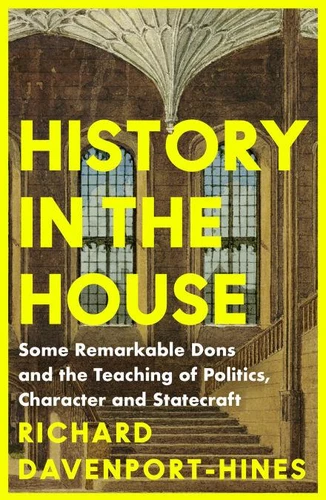
History in the House. Some Remarkable Dons and the Teaching of Politics, Character and Statecraft
Par :Formats :
Disponible dans votre compte client Decitre ou Furet du Nord dès validation de votre commande. Le format ePub protégé est :
- Compatible avec une lecture sur My Vivlio (smartphone, tablette, ordinateur)
- Compatible avec une lecture sur liseuses Vivlio
- Pour les liseuses autres que Vivlio, vous devez utiliser le logiciel Adobe Digital Edition. Non compatible avec la lecture sur les liseuses Kindle, Remarkable et Sony
- Non compatible avec un achat hors France métropolitaine
 , qui est-ce ?
Notre partenaire de plateforme de lecture numérique où vous retrouverez l'ensemble de vos ebooks gratuitement
Pour en savoir plus sur nos ebooks, consultez notre aide en ligne ici
C'est si simple ! Lisez votre ebook avec l'app Vivlio sur votre tablette, mobile ou ordinateur :

- Nombre de pages432
- FormatePub
- ISBN978-0-00-828574-6
- EAN9780008285746
- Date de parution20/06/2024
- Protection num.Adobe DRM
- Infos supplémentairesepub
- ÉditeurWilliam Collins
Résumé
A Spectator Best Book of the Year; An Aspects of History Best Book of the Year; An Engelsberg Ideas Best Book of the Year
Five hundred years ago, Thomas Wolsey endowed in Oxford a foundation he called Cardinal's College. Henry VIII, the monarch who dismissed and ruined him, re-established it as Christ Church later in his reign as an institution rich, spacious and imposing beyond any other. It would help young men of Tudor England and beyond to study history, improve their minds, enlarge imaginations and broaden experience for the benefit of the realm - under the tutelage, of course, of some remarkable dons.
Generations of students had their intellects and world perspectives shaped by Oxford.
It was believed that the study of history - touching the ancient world at one end and modern politics at the other - interlaced with geography, economics, political science, law and modern languages, would demonstrate the reasons for the success or failure of states. The student would be taught - in Sir Isaiah Berlin's memorable phrase - to 'spot the bunk!' In this book, acclaimed historian Richard Davenport- Hines examines the intimate connections between British politics, statecraft and the Oxford University history course.
He explores the temperaments, ideas, imagination, prejudices, intentions and influence of a select and self-regulated group of men who taught modern history at Christ Church: Frederick York Powell, Arthur Hassall, Keith Feiling, J. C. Masterman, Roy Harrod, Patrick Gordon Walker, Hugh Trevor-Roper and Robert Blake; by turns an unruly Victorian radical, a staunch legitimist of the Protestant settlement, a Tory, a Whig, a Keynesian, a socialist, a rationalist who enjoyed mischief and a student of realpolitik. These dons, with their challenging and sometimes contradictory opinions, explored with their pupils the wielding of power, the art of persuasion and the exercise of civil and political responsibility.
Intelligent, strenuous and aware of the treachery and uncontrollability of things in the world, they studied the crimes, follies, misfortunes, incapacity, muddle and disloyalty of humankind in every generation. History in the House offers an unforgettable portrait of these men, their enduring influence and the significance of their arguments to public life today.
It was believed that the study of history - touching the ancient world at one end and modern politics at the other - interlaced with geography, economics, political science, law and modern languages, would demonstrate the reasons for the success or failure of states. The student would be taught - in Sir Isaiah Berlin's memorable phrase - to 'spot the bunk!' In this book, acclaimed historian Richard Davenport- Hines examines the intimate connections between British politics, statecraft and the Oxford University history course.
He explores the temperaments, ideas, imagination, prejudices, intentions and influence of a select and self-regulated group of men who taught modern history at Christ Church: Frederick York Powell, Arthur Hassall, Keith Feiling, J. C. Masterman, Roy Harrod, Patrick Gordon Walker, Hugh Trevor-Roper and Robert Blake; by turns an unruly Victorian radical, a staunch legitimist of the Protestant settlement, a Tory, a Whig, a Keynesian, a socialist, a rationalist who enjoyed mischief and a student of realpolitik. These dons, with their challenging and sometimes contradictory opinions, explored with their pupils the wielding of power, the art of persuasion and the exercise of civil and political responsibility.
Intelligent, strenuous and aware of the treachery and uncontrollability of things in the world, they studied the crimes, follies, misfortunes, incapacity, muddle and disloyalty of humankind in every generation. History in the House offers an unforgettable portrait of these men, their enduring influence and the significance of their arguments to public life today.
A propos de Richard Davenport-Hines
Auden
E-book
9,49 €

Proust au Majestic
Grand Format
25,90 €