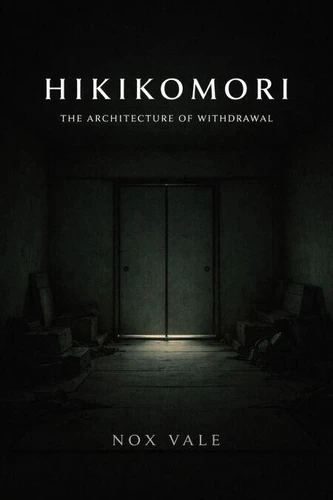
What This Book Is Hikikomori: The Architecture of Withdrawal by Nox Vale is a short, immersive nonfiction work that explores extreme social withdrawal as both a psychological condition and a signal from modern civilization. It moves through: The lived reality of isolation The cultural machinery that produces it The strange inner world that replaces ordinary life It reads somewhere between case study, philosophical essay, and quiet horror. What You'll Experience At first, you're an observer. You're looking at a closed room.
A person inside. A life paused. Then something shifts. The book starts peeling back layers: Shame becomes structural, almost gravitational Time stops behaving normally Identity begins to dissolve without other people to reflect it By the middle, the question changes from: "Why do they withdraw?" to: "Why don't more people?" What Makes It Different This isn't a clinical guide and it's not self-help. It treats hikikomori as: A failure mode of modern society A quiet refusal to participate Possibly even an early adaptation to a world where physical presence is optional There's a strong undercurrent of philosophy running through it, echoing figures like Arthur Schopenhauer and Emil Cioran, where opting out starts to look less like weakness and more like a kind of clarity.
What This Book Is Hikikomori: The Architecture of Withdrawal by Nox Vale is a short, immersive nonfiction work that explores extreme social withdrawal as both a psychological condition and a signal from modern civilization. It moves through: The lived reality of isolation The cultural machinery that produces it The strange inner world that replaces ordinary life It reads somewhere between case study, philosophical essay, and quiet horror. What You'll Experience At first, you're an observer. You're looking at a closed room.
A person inside. A life paused. Then something shifts. The book starts peeling back layers: Shame becomes structural, almost gravitational Time stops behaving normally Identity begins to dissolve without other people to reflect it By the middle, the question changes from: "Why do they withdraw?" to: "Why don't more people?" What Makes It Different This isn't a clinical guide and it's not self-help. It treats hikikomori as: A failure mode of modern society A quiet refusal to participate Possibly even an early adaptation to a world where physical presence is optional There's a strong undercurrent of philosophy running through it, echoing figures like Arthur Schopenhauer and Emil Cioran, where opting out starts to look less like weakness and more like a kind of clarity.


 , qui est-ce ?