
Nouveauté
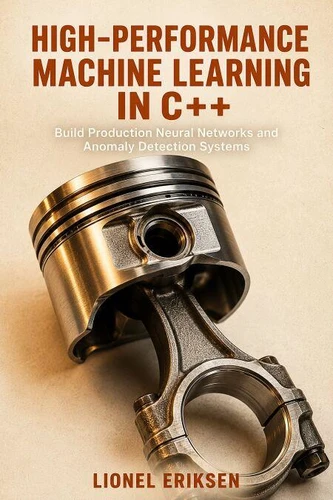
High-Performance Machine Learning in C++. Build Production Neural Networks and Anomaly Detection Systems
Par :Formats :
Disponible dans votre compte client Decitre ou Furet du Nord dès validation de votre commande. Le format ePub est :
- Compatible avec une lecture sur My Vivlio (smartphone, tablette, ordinateur)
- Compatible avec une lecture sur liseuses Vivlio
- Pour les liseuses autres que Vivlio, vous devez utiliser le logiciel Adobe Digital Edition. Non compatible avec la lecture sur les liseuses Kindle, Remarkable et Sony
 , qui est-ce ?
Notre partenaire de plateforme de lecture numérique où vous retrouverez l'ensemble de vos ebooks gratuitement
Pour en savoir plus sur nos ebooks, consultez notre aide en ligne ici
C'est si simple ! Lisez votre ebook avec l'app Vivlio sur votre tablette, mobile ou ordinateur :

- FormatePub
- ISBN8259604414
- EAN9798259604414
- Date de parution29/06/2026
- Protection num.pas de protection
- Taille1 Mo
- Infos supplémentairesepub
- ÉditeurChiify
Résumé
Machine learning C++ and high-performance computing converge in this hands-on guide for building fast AI models from the ground up. Lionel Eriksen teaches you to implement training, inference, and numerical routines where speed truly matters-close to the metal. From optimizing memory access to parallelizing algorithms with OpenMP and SIMD, you'll master techniques that make your models run faster than Python-based alternatives.
Practical exercises cover gradient descent, backpropagation, and custom kernels for CPUs. No fluff-just C++ code that delivers real-world performance gains. Whether you're a beginner or seasoned developer, this book bridges theory and practice. Competitor authors: [placeholder] and [placeholder] offer similar topics, but Ibarra's focus on low-level optimization and practical implementation sets this apart. What You'll Learn Build neural networks from scratch using raw C++ and Eigen Implement gradient descent, backpropagation, and loss functions Optimize memory layout and cache usage for faster training Parallelize loops with OpenMP and vectorize with SIMD intrinsics Write custom numerical routines for matrix operations Profile and debug performance bottlenecks with tools like perf and Valgrind Deploy models in embedded systems and low-latency applications Who This Book Is For Software engineers, data scientists, and C++ developers who want to push AI performance beyond scripting languages.
Ideal for those building real-time systems, game AI, or high-frequency trading models. Table of Contents Why C++ for Machine Learning? Setting Up Your Development Environment Data Structures for High Performance Linear Algebra Routines from Scratch Implementing Gradient Descent Building a Neural Network Layer Training with Backpropagation Parallelization with OpenMP Vectorization with SIMD Memory Optimization Techniques Profiling and Benchmarking Inference Optimization Deploying to Embedded Systems Case Study: Real-Time Object Detection Get ready to write C++ that makes AI fly.
No Python wrappers-just raw speed and full control.
Practical exercises cover gradient descent, backpropagation, and custom kernels for CPUs. No fluff-just C++ code that delivers real-world performance gains. Whether you're a beginner or seasoned developer, this book bridges theory and practice. Competitor authors: [placeholder] and [placeholder] offer similar topics, but Ibarra's focus on low-level optimization and practical implementation sets this apart. What You'll Learn Build neural networks from scratch using raw C++ and Eigen Implement gradient descent, backpropagation, and loss functions Optimize memory layout and cache usage for faster training Parallelize loops with OpenMP and vectorize with SIMD intrinsics Write custom numerical routines for matrix operations Profile and debug performance bottlenecks with tools like perf and Valgrind Deploy models in embedded systems and low-latency applications Who This Book Is For Software engineers, data scientists, and C++ developers who want to push AI performance beyond scripting languages.
Ideal for those building real-time systems, game AI, or high-frequency trading models. Table of Contents Why C++ for Machine Learning? Setting Up Your Development Environment Data Structures for High Performance Linear Algebra Routines from Scratch Implementing Gradient Descent Building a Neural Network Layer Training with Backpropagation Parallelization with OpenMP Vectorization with SIMD Memory Optimization Techniques Profiling and Benchmarking Inference Optimization Deploying to Embedded Systems Case Study: Real-Time Object Detection Get ready to write C++ that makes AI fly.
No Python wrappers-just raw speed and full control.