
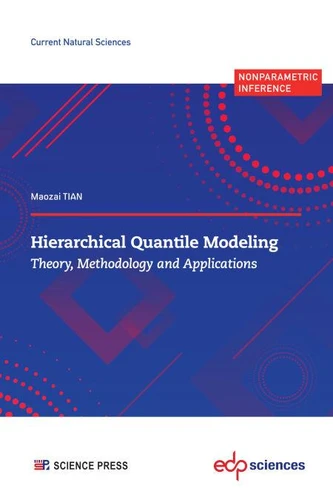
Hierarchical Quantile Modeling. Theory, Methodology and Applications
Par :Formats :
Disponible dans votre compte client Decitre ou Furet du Nord dès validation de votre commande. Le format PDF est :
- Compatible avec une lecture sur My Vivlio (smartphone, tablette, ordinateur)
- Compatible avec une lecture sur liseuses Vivlio
- Pour les liseuses autres que Vivlio, vous devez utiliser le logiciel Adobe Digital Edition. Non compatible avec la lecture sur les liseuses Kindle, Remarkable et Sony
 , qui est-ce ?
Notre partenaire de plateforme de lecture numérique où vous retrouverez l'ensemble de vos ebooks gratuitement
Pour en savoir plus sur nos ebooks, consultez notre aide en ligne ici
C'est si simple ! Lisez votre ebook avec l'app Vivlio sur votre tablette, mobile ou ordinateur :

- Nombre de pages752
- FormatPDF
- ISBN978-2-7598-3720-5
- EAN9782759837205
- Date de parution07/11/2024
- Protection num.Digital Watermarking
- Taille31 Mo
- Infos supplémentairespdf
- ÉditeurEDP Sciences
Résumé
This book offers a concise and comprehensive introduction to Hierarchical Quantile Modeling, a modern statistical methodology that extends traditional hierarchical models and quantile regression techniques to analyze complex data structures often found in fields like biology, economics, and education. Unlike classic models, Hierarchical Quantile Modeling accommodates heteroscedasticity and nonparametric relationships, allowing for a detailed study of the entire conditional distribution of a response variable.
The book is structured in four parts: an introduction to hierarchical modeling, a detailed look at quantile regression, an in-depth exploration of Hierarchical Quantile Modeling, and practical applications using real-world hierarchical, repeated, and clustered data.
Drawing on the author's decade-long experience in research and teaching, this guide is ideal for graduate students, researchers, and practitioners. It includes examples and software guidance using R, S-plus, SAS, and SPSS, making it a valuable resource for anyone interested in advanced statistical analysis.
Drawing on the author's decade-long experience in research and teaching, this guide is ideal for graduate students, researchers, and practitioners. It includes examples and software guidance using R, S-plus, SAS, and SPSS, making it a valuable resource for anyone interested in advanced statistical analysis.