SOLDES
Jusqu'à -70% sur une sélection d'articles*

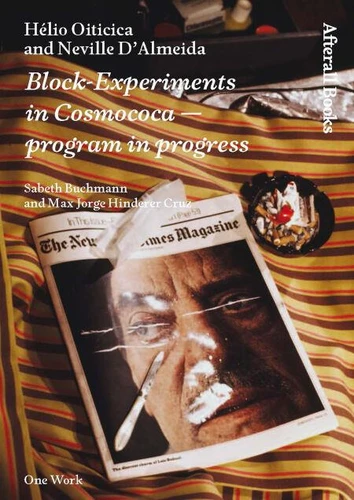
Hélio Oiticica and Neville D'Almeida. Block-Experiments in Cosmococa--Program in Progress
Par : ,Formats :
Disponible dans votre compte client Decitre ou Furet du Nord dès validation de votre commande. Le format ePub protégé est :
- Compatible avec une lecture sur My Vivlio (smartphone, tablette, ordinateur)
- Compatible avec une lecture sur liseuses Vivlio
- Pour les liseuses autres que Vivlio, vous devez utiliser le logiciel Adobe Digital Edition. Non compatible avec la lecture sur les liseuses Kindle, Remarkable et Sony
- Non compatible avec un achat hors France métropolitaine
 , qui est-ce ?
Notre partenaire de plateforme de lecture numérique où vous retrouverez l'ensemble de vos ebooks gratuitement
Pour en savoir plus sur nos ebooks, consultez notre aide en ligne ici
C'est si simple ! Lisez votre ebook avec l'app Vivlio sur votre tablette, mobile ou ordinateur :

- Nombre de pages120
- FormatePub
- ISBN978-1-84638-107-2
- EAN9781846381072
- Date de parution22/03/2013
- Protection num.Adobe DRM
- Taille5 Mo
- Infos supplémentairesepub
- ÉditeurAfterall Books
Résumé
An illustrated study that casts a new light on Oiticica's most important work of "quasi-cinema" on its fortieth anniversary. Hélio Oiticica (1937-1980) occupies a central position in the Latin American avant-garde of the postwar era. Associated with the Rio de Janeiro-based neo-concretist movement at the beginning of his career, Oiticica moved from object production to the creation of chromatically opulent and sensually engulfing large-scale installations or wearable garments.
Building on the idea for a film by Brazilian underground filmmaker Neville D'Almeida, Oiticica developed the concept for Block-Experiments in Cosmococa-Program in Progress (1973-1974) as an "open program": a series of nine proposals for environments, each consisting of slide projections, soundtracks, leisure facilities, drawings (with cocaine used as pigment), and instructions for visitors. It is the epitome of what the artist called his "quasi-cinema" work-his most controversial production, and perhaps his most direct effort to merge art and life.
Presented publicly for the first time in 1992, these works have been included in major international exhibitions in Los Angeles, Chicago, London, and New York. Drawing on unpublished primary sources, letters, and writings by Oiticica himself, this illustrated examination of Oiticica's work considers the vast catalog of theoretical references the artist's work relies on, from anticolonial materialism to French phenomenology and postmodern media theory to the work of Jean-Luc Godard, Andy Warhol, and Brazilian avant-garde filmmakers.
It discusses Oiticica's work in relation to the diaspora of Brazilian intellectuals during the military dictatorship, the politics of media circulation, the commercialization of New York's queer underground, the explicit use of cocaine as means of production, and possible future reappraisals of Oiticica's work.
Building on the idea for a film by Brazilian underground filmmaker Neville D'Almeida, Oiticica developed the concept for Block-Experiments in Cosmococa-Program in Progress (1973-1974) as an "open program": a series of nine proposals for environments, each consisting of slide projections, soundtracks, leisure facilities, drawings (with cocaine used as pigment), and instructions for visitors. It is the epitome of what the artist called his "quasi-cinema" work-his most controversial production, and perhaps his most direct effort to merge art and life.
Presented publicly for the first time in 1992, these works have been included in major international exhibitions in Los Angeles, Chicago, London, and New York. Drawing on unpublished primary sources, letters, and writings by Oiticica himself, this illustrated examination of Oiticica's work considers the vast catalog of theoretical references the artist's work relies on, from anticolonial materialism to French phenomenology and postmodern media theory to the work of Jean-Luc Godard, Andy Warhol, and Brazilian avant-garde filmmakers.
It discusses Oiticica's work in relation to the diaspora of Brazilian intellectuals during the military dictatorship, the politics of media circulation, the commercialization of New York's queer underground, the explicit use of cocaine as means of production, and possible future reappraisals of Oiticica's work.