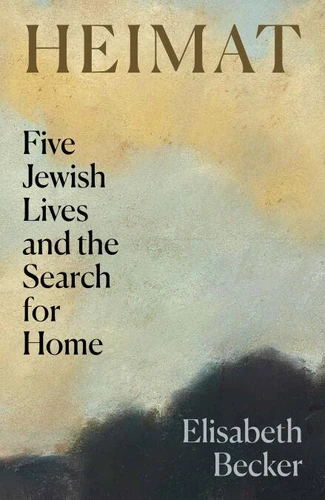
Heimat. Five Jewish Lives and the Search for Home
Par :Formats :
Disponible dans votre compte client Decitre ou Furet du Nord dès validation de votre commande. Le format ePub protégé est :
- Compatible avec une lecture sur My Vivlio (smartphone, tablette, ordinateur)
- Compatible avec une lecture sur liseuses Vivlio
- Pour les liseuses autres que Vivlio, vous devez utiliser le logiciel Adobe Digital Edition. Non compatible avec la lecture sur les liseuses Kindle, Remarkable et Sony
- Non compatible avec un achat hors France métropolitaine
 , qui est-ce ?
Notre partenaire de plateforme de lecture numérique où vous retrouverez l'ensemble de vos ebooks gratuitement
Pour en savoir plus sur nos ebooks, consultez notre aide en ligne ici
C'est si simple ! Lisez votre ebook avec l'app Vivlio sur votre tablette, mobile ou ordinateur :

- Nombre de pages304
- Date de parution16/03/2027
- FormatePub
- ISBN978-1-83674-355-2
- EAN9781836743552
- Protection num.Adobe DRM
- Infos supplémentairesepub
- ÉditeurVerso
Résumé
A moving meditation on exile and home told through the lives of five Jewish Berliners: Walter Benjamin, Hannah Arendt, Albert Einstein, Max Liebermann and Mascha Kaléko. Heimat is not a word that can be translated easily: it means home, or the spirit of place. When Elisabeth Becker moves to Berlin from New York she goes in search of that spirit among the streets and monuments, navigating between a catastrophic past and a precarious present.
As guides to the ghosts of Jewish Berlin, Becker walks with writer and thinker Walter Benjamin, political theorist and philosopher Hannah Arendt, scientist Albert Einstein, artist Max Liebermann and poet Mascha Kaléko. Each experienced the reconfiguration of home in 1930s Berlin in the face of rising fascism, and all except one sought a new sanctuary abroad. Benjamin first fled to Paris and then committed suicide when he was unable to escape through Spain.
Arendt made it to the US but wrestled with her understanding and reconciling her past for the rest of her life. Einstein sought comfort in the peace movement and the universal community of science after fleeing to Princeton, New Jersey. Kaléko, who lived her own exile largely in New York City and Jerusalem, continued to long for Berlin across her own exile, with this sentiment that marking her emigration poems.
And Liebermann attempted to find solace in art, while remaining in Berlin in times of great tumult, where he died in 1935. These lives are told in conversation with Berlin today, which is still dealing with the legacy of its past, as well as a new Jewish present. Becker explores the city in search of its ghosts and its future, asking fundamental questions about the nature of the city, the idea of home and Jewish belonging at times of great uncertainty.
Ultimately, she suggests that Heimat exists at the interstices between place and text, in the spaces that we live as well as the stories that we tell: and that even when lost, hope in Heimat remains.
As guides to the ghosts of Jewish Berlin, Becker walks with writer and thinker Walter Benjamin, political theorist and philosopher Hannah Arendt, scientist Albert Einstein, artist Max Liebermann and poet Mascha Kaléko. Each experienced the reconfiguration of home in 1930s Berlin in the face of rising fascism, and all except one sought a new sanctuary abroad. Benjamin first fled to Paris and then committed suicide when he was unable to escape through Spain.
Arendt made it to the US but wrestled with her understanding and reconciling her past for the rest of her life. Einstein sought comfort in the peace movement and the universal community of science after fleeing to Princeton, New Jersey. Kaléko, who lived her own exile largely in New York City and Jerusalem, continued to long for Berlin across her own exile, with this sentiment that marking her emigration poems.
And Liebermann attempted to find solace in art, while remaining in Berlin in times of great tumult, where he died in 1935. These lives are told in conversation with Berlin today, which is still dealing with the legacy of its past, as well as a new Jewish present. Becker explores the city in search of its ghosts and its future, asking fundamental questions about the nature of the city, the idea of home and Jewish belonging at times of great uncertainty.
Ultimately, she suggests that Heimat exists at the interstices between place and text, in the spaces that we live as well as the stories that we tell: and that even when lost, hope in Heimat remains.