
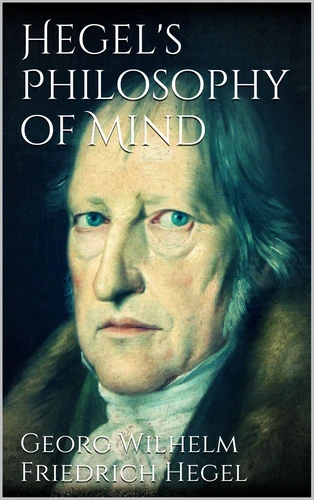
Hegel's Philosophy of Mind
Par :Formats :
Disponible dans votre compte client Decitre ou Furet du Nord dès validation de votre commande. Le format ePub est :
- Compatible avec une lecture sur My Vivlio (smartphone, tablette, ordinateur)
- Compatible avec une lecture sur liseuses Vivlio
- Pour les liseuses autres que Vivlio, vous devez utiliser le logiciel Adobe Digital Edition. Non compatible avec la lecture sur les liseuses Kindle, Remarkable et Sony
 , qui est-ce ?
Notre partenaire de plateforme de lecture numérique où vous retrouverez l'ensemble de vos ebooks gratuitement
Pour en savoir plus sur nos ebooks, consultez notre aide en ligne ici
C'est si simple ! Lisez votre ebook avec l'app Vivlio sur votre tablette, mobile ou ordinateur :

- Nombre de pages467
- FormatePub
- ISBN978-3-7481-8145-3
- EAN9783748181453
- Date de parution22/11/2018
- Protection num.Digital Watermarking
- Taille659 Ko
- Infos supplémentairesepub
- ÉditeurBooks on Demand
Résumé
The knowledge of Mind is the highest and hardest, just because it is the most "concrete" of sciences. The significance of that "absolute" commandment, Know thyself-whether we look at it in itself or under the historical circumstances of its first utterance-is not to promote mere self-knowledge in respect of the particular capacities, character, propensities, and foibles of the single self. The knowledge it commands means that of man's genuine reality-of what is essentially and ultimately true and real-of mind as the true and essential being.
Equally little is it the purport of mental philosophy to teach what is called knowledge of men-the knowledge whose aim is to detect the peculiarities, passions, and foibles of other men, and lay bare what are called the recesses of the human heart. Information of this kind is, for one thing, meaningless, unless on the assumption that we know the universal-man as man, and, that always must be, as mind.
And for another, being only engaged with casual, insignificant and untrue aspects of mental life, it fails to reach the underlying essence of them all-the mind itself.
Equally little is it the purport of mental philosophy to teach what is called knowledge of men-the knowledge whose aim is to detect the peculiarities, passions, and foibles of other men, and lay bare what are called the recesses of the human heart. Information of this kind is, for one thing, meaningless, unless on the assumption that we know the universal-man as man, and, that always must be, as mind.
And for another, being only engaged with casual, insignificant and untrue aspects of mental life, it fails to reach the underlying essence of them all-the mind itself.
A propos de Georg Wilhelm Friedrich Hegel


4/5
9,90 €


4/5
ESTHETIQUE.. Tome 2
Poche
11,70 €

4,50 €

3,87 €

13,99 €

13,99 €
5,49 €
13,99 €

The Logic Of Hegel (Unabridged)
Audiobook
4,22 €
Philosophy of Mind
E-book
1,99 €

4,99 €

100 citations de Hegel
Audiobook
1,99 €

4,99 €

La Logique subjective
E-book
2,99 €

9,99 €

Frühe Schriften
E-book
34,99 €