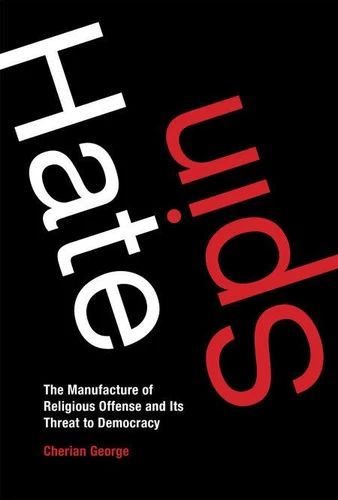
Hate Spin. The Manufacture of Religious Offense and Its Threat to Democracy
Par :Formats :
Disponible dans votre compte client Decitre ou Furet du Nord dès validation de votre commande. Le format ePub protégé est :
- Compatible avec une lecture sur My Vivlio (smartphone, tablette, ordinateur)
- Compatible avec une lecture sur liseuses Vivlio
- Pour les liseuses autres que Vivlio, vous devez utiliser le logiciel Adobe Digital Edition. Non compatible avec la lecture sur les liseuses Kindle, Remarkable et Sony
- Non compatible avec un achat hors France métropolitaine
 , qui est-ce ?
Notre partenaire de plateforme de lecture numérique où vous retrouverez l'ensemble de vos ebooks gratuitement
Pour en savoir plus sur nos ebooks, consultez notre aide en ligne ici
C'est si simple ! Lisez votre ebook avec l'app Vivlio sur votre tablette, mobile ou ordinateur :

- Nombre de pages328
- FormatePub
- ISBN978-0-262-33607-9
- EAN9780262336079
- Date de parution23/09/2016
- Protection num.Adobe DRM
- Taille531 Ko
- Infos supplémentairesepub
- ÉditeurThe MIT Press
Résumé
How right-wing political entrepreneurs around the world use religious offense-both given and taken-to mobilize supporters and marginalize opponents. In the United States, elements of the religious right fuel fears of an existential Islamic threat, spreading anti-Muslim rhetoric into mainstream politics. In Indonesia, Muslim absolutists urge suppression of churches and minority sects, fostering a climate of rising intolerance.
In India, Narendra Modi's radical supporters instigate communal riots and academic censorship in pursuit of their Hindu nationalist vision. Outbreaks of religious intolerance are usually assumed to be visceral and spontaneous. But in Hate Spin, Cherian George shows that they often involve sophisticated campaigns manufactured by political opportunists to mobilize supporters and marginalize opponents.
Right-wing networks orchestrate the giving of offense and the taking of offense as instruments of identity politics, exploiting democratic space to promote agendas that undermine democratic values. George calls this strategy "hate spin"-a double-sided technique that combines hate speech (incitement through vilification) with manufactured offense-taking (the performing of righteous indignation). It is deployed in societies as diverse as Buddhist Myanmar and Orthodox Christian Russia. George looks at the world's three largest democracies, where intolerant groups within India's Hindu right, America's Christian right, and Indonesia's Muslim right are all accomplished users of hate spin.
He also shows how the Internet and Google have opened up new opportunities for cross-border hate spin. George argues that governments must protect vulnerable communities by prohibiting calls to action that lead directly to discrimination and violence. But laws that try to protect believers' feelings against all provocative expression invariably backfire. They arm hate spin agents' offense-taking campaigns with legal ammunition.
Anti-discrimination laws and a commitment to religious equality will protect communities more meaningfully than misguided attempts to insulate them from insult.
In India, Narendra Modi's radical supporters instigate communal riots and academic censorship in pursuit of their Hindu nationalist vision. Outbreaks of religious intolerance are usually assumed to be visceral and spontaneous. But in Hate Spin, Cherian George shows that they often involve sophisticated campaigns manufactured by political opportunists to mobilize supporters and marginalize opponents.
Right-wing networks orchestrate the giving of offense and the taking of offense as instruments of identity politics, exploiting democratic space to promote agendas that undermine democratic values. George calls this strategy "hate spin"-a double-sided technique that combines hate speech (incitement through vilification) with manufactured offense-taking (the performing of righteous indignation). It is deployed in societies as diverse as Buddhist Myanmar and Orthodox Christian Russia. George looks at the world's three largest democracies, where intolerant groups within India's Hindu right, America's Christian right, and Indonesia's Muslim right are all accomplished users of hate spin.
He also shows how the Internet and Google have opened up new opportunities for cross-border hate spin. George argues that governments must protect vulnerable communities by prohibiting calls to action that lead directly to discrimination and violence. But laws that try to protect believers' feelings against all provocative expression invariably backfire. They arm hate spin agents' offense-taking campaigns with legal ammunition.
Anti-discrimination laws and a commitment to religious equality will protect communities more meaningfully than misguided attempts to insulate them from insult.