
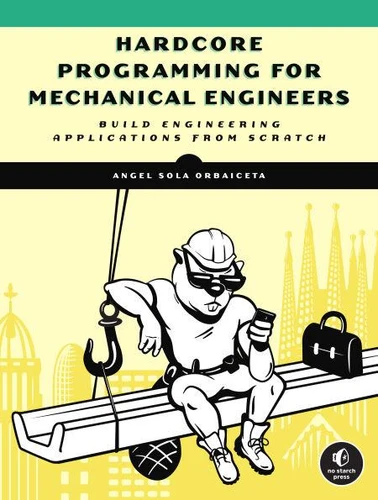
Hardcore Programming for Mechanical Engineers. Build Engineering Applications from Scratch
Par :Formats :
Disponible dans votre compte client Decitre ou Furet du Nord dès validation de votre commande. Le format ePub est :
- Compatible avec une lecture sur My Vivlio (smartphone, tablette, ordinateur)
- Compatible avec une lecture sur liseuses Vivlio
- Pour les liseuses autres que Vivlio, vous devez utiliser le logiciel Adobe Digital Edition. Non compatible avec la lecture sur les liseuses Kindle, Remarkable et Sony
 , qui est-ce ?
Notre partenaire de plateforme de lecture numérique où vous retrouverez l'ensemble de vos ebooks gratuitement
Pour en savoir plus sur nos ebooks, consultez notre aide en ligne ici
C'est si simple ! Lisez votre ebook avec l'app Vivlio sur votre tablette, mobile ou ordinateur :

- Nombre de pages600
- FormatePub
- ISBN978-1-7185-0079-2
- EAN9781718500792
- Date de parution22/06/2021
- Protection num.pas de protection
- Taille30 Mo
- Infos supplémentairesepub
- ÉditeurNo Starch Press
Résumé
Hardcore Programming for Mechanical Engineers is for intermediate programmers who want to write good applications that solve tough engineering problems - from scratch. This book will teach you how to solve engineering problems with Python. The "hardcore" approach means that you will learn to get the correct results by coding everything from scratch. Forget relying on third-party software - there are no shortcuts on the path to proficiency.
Instead, using familiar concepts from linear algebra, geometry and physics, you'll write your own libraries, draw your own primitives, and build your own applications. Author Angel Sola covers core programming techniques mechanical engineers need to know, with a focus on high-quality code and automated unit testing for error-free implementations. After basic primers on Python and using the command line, you'll quickly develop a geometry toolbox, filling it with lines and shapes for diagramming problems.
As your understanding grows chapter-by-chapter, you'll create vector graphics and animations for dynamic simulations; you'll code algorithms that can do complex numerical computations; and you'll put all of this knowledge together to build a complete structural analysis application that solves a 2D truss problem - similar to the software projects conducted by real-world mechanical engineers. You'll learn: . How to use geometric primitives, like points and polygons, and implement matrices . Best practices for clean code, including unit testing, encapsulation, and expressive names . Processes for drawing images to the screen and creating animations inside Tkinter's Canvas widget . How to write programs that read from a file, parse the data, and produce vector images . Numerical methods for solving large systems of linear equations, like the Cholesky decomposition algorithm
Instead, using familiar concepts from linear algebra, geometry and physics, you'll write your own libraries, draw your own primitives, and build your own applications. Author Angel Sola covers core programming techniques mechanical engineers need to know, with a focus on high-quality code and automated unit testing for error-free implementations. After basic primers on Python and using the command line, you'll quickly develop a geometry toolbox, filling it with lines and shapes for diagramming problems.
As your understanding grows chapter-by-chapter, you'll create vector graphics and animations for dynamic simulations; you'll code algorithms that can do complex numerical computations; and you'll put all of this knowledge together to build a complete structural analysis application that solves a 2D truss problem - similar to the software projects conducted by real-world mechanical engineers. You'll learn: . How to use geometric primitives, like points and polygons, and implement matrices . Best practices for clean code, including unit testing, encapsulation, and expressive names . Processes for drawing images to the screen and creating animations inside Tkinter's Canvas widget . How to write programs that read from a file, parse the data, and produce vector images . Numerical methods for solving large systems of linear equations, like the Cholesky decomposition algorithm