Nouveauté
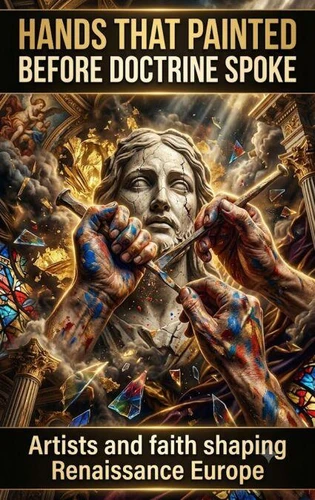
Hands that painted before doctrine spoke. Artists and faith shaping Renaissance Europe
Par :Formats :
Disponible dans votre compte client Decitre ou Furet du Nord dès validation de votre commande. Le format ePub est :
- Compatible avec une lecture sur My Vivlio (smartphone, tablette, ordinateur)
- Compatible avec une lecture sur liseuses Vivlio
- Pour les liseuses autres que Vivlio, vous devez utiliser le logiciel Adobe Digital Edition. Non compatible avec la lecture sur les liseuses Kindle, Remarkable et Sony
 , qui est-ce ?
Notre partenaire de plateforme de lecture numérique où vous retrouverez l'ensemble de vos ebooks gratuitement
Pour en savoir plus sur nos ebooks, consultez notre aide en ligne ici
C'est si simple ! Lisez votre ebook avec l'app Vivlio sur votre tablette, mobile ou ordinateur :

- Nombre de pages152
- FormatePub
- ISBN978-3-565-54590-2
- EAN9783565545902
- Date de parution08/07/2026
- Protection num.pas de protection
- Taille658 Ko
- Infos supplémentairesepub
- ÉditeurEmphaloz Publishing House
Résumé
When a patron commissioned an altarpiece in fifteenth-century Florence, they were not simply buying art. They were negotiating salvation, status, and civic memory through every pigment of ultramarine and stroke of gesso. This book examines the Renaissance not as a sudden cultural dawn, but as a calculated system of visual persuasion, where painters like Masaccio and Botticelli operated within a web of guild regulations, theological constraints, and mercantile ambition that determined what could be seen and who could see it.
At its core, the period's artistic explosion was a contest over who held the authority to represent the sacred. The shift from gold-leafed Byzantine iconography to perspectival realism was not purely aesthetic-it was a political claim that the material world, observed and recorded with mathematical precision, could reveal divine order more truthfully than symbol alone. Yet this claim came with consequences.
Artists who pushed naturalism too far risked accusations of vanity. Patrons who displayed too much wealth through chapel decoration invited clerical suspicion. And the very act of looking-at a fresco, a carved pulpit, a devotional panel-became a form of participation in a struggle between ecclesiastical authority and civic pride. By tracing the lives of painters, their contracts, and the controversies that surrounded their work, the book reveals how Renaissance art was always a negotiation between the sacred and the secular.
Across Europe, from the Medici chapels to the Sistine ceiling, the hand that held the brush answered to more than inspiration.
At its core, the period's artistic explosion was a contest over who held the authority to represent the sacred. The shift from gold-leafed Byzantine iconography to perspectival realism was not purely aesthetic-it was a political claim that the material world, observed and recorded with mathematical precision, could reveal divine order more truthfully than symbol alone. Yet this claim came with consequences.
Artists who pushed naturalism too far risked accusations of vanity. Patrons who displayed too much wealth through chapel decoration invited clerical suspicion. And the very act of looking-at a fresco, a carved pulpit, a devotional panel-became a form of participation in a struggle between ecclesiastical authority and civic pride. By tracing the lives of painters, their contracts, and the controversies that surrounded their work, the book reveals how Renaissance art was always a negotiation between the sacred and the secular.
Across Europe, from the Medici chapels to the Sistine ceiling, the hand that held the brush answered to more than inspiration.