
The author is a dedicated scholar with a lifelong fascination for History and Crime. This interest, nurtured since childhood, forms the bedrock of their work. They hold a postgraduate-level education, with advanced studies in the fields of Business and Computing, a background that lends a unique structural perspective to their research. A committed autodidact, the author dedicates their free time to extensive, self-directed study, drawing upon decades of intellectual curiosity to inform their writing.
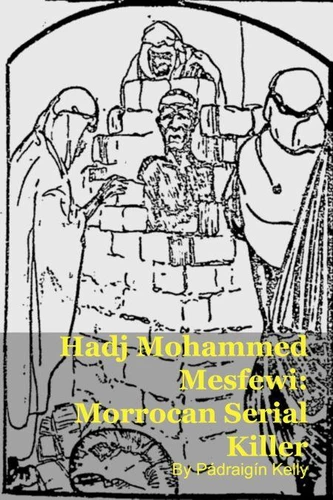
Hadj Mohammed Mesfewi: Morrocan Serial Killer
Par :Formats :
Disponible dans votre compte client Decitre ou Furet du Nord dès validation de votre commande. Le format ePub est :
- Compatible avec une lecture sur My Vivlio (smartphone, tablette, ordinateur)
- Compatible avec une lecture sur liseuses Vivlio
- Pour les liseuses autres que Vivlio, vous devez utiliser le logiciel Adobe Digital Edition. Non compatible avec la lecture sur les liseuses Kindle, Remarkable et Sony
 , qui est-ce ?
Notre partenaire de plateforme de lecture numérique où vous retrouverez l'ensemble de vos ebooks gratuitement
Pour en savoir plus sur nos ebooks, consultez notre aide en ligne ici
C'est si simple ! Lisez votre ebook avec l'app Vivlio sur votre tablette, mobile ou ordinateur :

- FormatePub
- ISBN8232096748
- EAN9798232096748
- Date de parution11/12/2025
- Protection num.pas de protection
- Infos supplémentairesepub
- ÉditeurDraft2Digital
Résumé
Hadj Mohammed Mesfewi: Morrocan Serial Killer"Hadj Mohammed Mesfewi: Moroccan Serial Killer" is a memoir by Inspector Brahim El-Fassi, detailing his investigation into a serial killer in Marrakesh in 1906. The narrative begins with El-Fassi reflecting on the case from 1920, looking back at the political instability of 1906, when Morocco was under increasing European control, culminating in the Algeciras Conference which further eroded the Sultan's sovereignty.
El-Fassi describes the tension in Marrakesh due to the Sultan's brother, Mawlay ?Abd al-?afi?, gathering support for a rebellion against European influence. Amidst this political turmoil, El-Fassi noticed a disturbing pattern of young women disappearing. Initially dismissed by his superior, Chief Inspector Moulay Hassan, El-Fassi conducted his own private investigation. He meticulously tracked seventeen disappearances over a year, all involving young, respectable women who had mentioned needing letters written and were last seen in the older, commercial quarters of the city, particularly the leather workers' quarter.
The breakthrough came on April 24, 1906, when Lalla Fatima bint Ahmed reported her daughter Amina missing, having traced her last known whereabouts to the shop of Hadj Mohammed Mesfewi, a seemingly respectable shoemaker and letter writer. El-Fassi, who had known and patronized Mesfewi for years, was initially resistant to the idea that such a pious and respected craftsman could be involved.
El-Fassi describes the tension in Marrakesh due to the Sultan's brother, Mawlay ?Abd al-?afi?, gathering support for a rebellion against European influence. Amidst this political turmoil, El-Fassi noticed a disturbing pattern of young women disappearing. Initially dismissed by his superior, Chief Inspector Moulay Hassan, El-Fassi conducted his own private investigation. He meticulously tracked seventeen disappearances over a year, all involving young, respectable women who had mentioned needing letters written and were last seen in the older, commercial quarters of the city, particularly the leather workers' quarter.
The breakthrough came on April 24, 1906, when Lalla Fatima bint Ahmed reported her daughter Amina missing, having traced her last known whereabouts to the shop of Hadj Mohammed Mesfewi, a seemingly respectable shoemaker and letter writer. El-Fassi, who had known and patronized Mesfewi for years, was initially resistant to the idea that such a pious and respected craftsman could be involved.
A propos de Pádraigín Kelly

3,49 €