
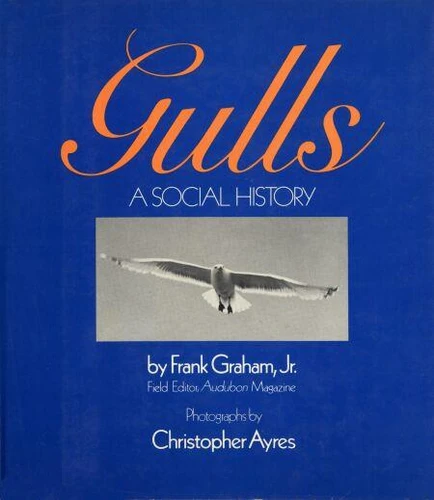
Gulls. A Social History
Par :Formats :
Disponible dans votre compte client Decitre ou Furet du Nord dès validation de votre commande. Le format ePub protégé est :
- Compatible avec une lecture sur My Vivlio (smartphone, tablette, ordinateur)
- Compatible avec une lecture sur liseuses Vivlio
- Pour les liseuses autres que Vivlio, vous devez utiliser le logiciel Adobe Digital Edition. Non compatible avec la lecture sur les liseuses Kindle, Remarkable et Sony
- Non compatible avec un achat hors France métropolitaine
 , qui est-ce ?
Notre partenaire de plateforme de lecture numérique où vous retrouverez l'ensemble de vos ebooks gratuitement
Pour en savoir plus sur nos ebooks, consultez notre aide en ligne ici
C'est si simple ! Lisez votre ebook avec l'app Vivlio sur votre tablette, mobile ou ordinateur :

- Nombre de pages192
- FormatePub
- ISBN978-0-307-82879-8
- EAN9780307828798
- Date de parution06/03/2013
- Protection num.Adobe DRM
- Taille2 Mo
- Infos supplémentairesepub
- ÉditeurRandom House
Résumé
This is the story of those marvelously adaptable birds-the gulls-and the most destructive of animals: man. Over the past 150 years man's actions have thrown some species of gulls totally out of context with their world, yet they have managed not only to survive but, for better or worse, to multiply at a rate that matches man's own. Nature fitted the forty-four species of gulls to be efficient predators and scavengers, and for hundreds of years they lived the precarious existence of wild things, foraging along the shore and feeding on birds' eggs and nestlings.
When man arrived on the scene, they rapidly learned to follow the fishing boats and even went into the fields to eat the insects turned up by the plow-at one point saving an entire harvest by consuming swarms of grasshoppers. The nineteenth-century craze for plumage on women's fashions nearly extirpated several kinds of gulls from our coasts. At last naturalists and concerned laymen established bird-protection societies to halt the indiscriminate slaughter.
Then a new element entered the scene: open garbage dumps. The graceful predators became omnipresent scavengers whose population explosion for a time seemed to have no end; whose range extended year after year; whose feet carried contaminants from dumps to reservoirs; who endangered aircraft; and who destroyed colonies of terns and puffins by consuming their eggs and young. Man's latest relations with gulls have been programs aimed at poisoning them and smashing their eggs.
Yet the gull remains the attractive, remarkable bird it always was. It is only man that has turned it into a pest. In addition to relating this pointed ecological case history, Gulls presents a handsomely illustrated account of the gull's natural life, highlighting those seen in America-the familiar Herring Gull, the Great Black-backed, the Ring-billed, the Kittiwake and the Laughing Gull-with vivid accounts of the author's trips to gull islands, both to watch the egg-destruction program and to study gull colonies.
When man arrived on the scene, they rapidly learned to follow the fishing boats and even went into the fields to eat the insects turned up by the plow-at one point saving an entire harvest by consuming swarms of grasshoppers. The nineteenth-century craze for plumage on women's fashions nearly extirpated several kinds of gulls from our coasts. At last naturalists and concerned laymen established bird-protection societies to halt the indiscriminate slaughter.
Then a new element entered the scene: open garbage dumps. The graceful predators became omnipresent scavengers whose population explosion for a time seemed to have no end; whose range extended year after year; whose feet carried contaminants from dumps to reservoirs; who endangered aircraft; and who destroyed colonies of terns and puffins by consuming their eggs and young. Man's latest relations with gulls have been programs aimed at poisoning them and smashing their eggs.
Yet the gull remains the attractive, remarkable bird it always was. It is only man that has turned it into a pest. In addition to relating this pointed ecological case history, Gulls presents a handsomely illustrated account of the gull's natural life, highlighting those seen in America-the familiar Herring Gull, the Great Black-backed, the Ring-billed, the Kittiwake and the Laughing Gull-with vivid accounts of the author's trips to gull islands, both to watch the egg-destruction program and to study gull colonies.