SOLDES
Jusqu'à -70% sur une sélection d'articles*

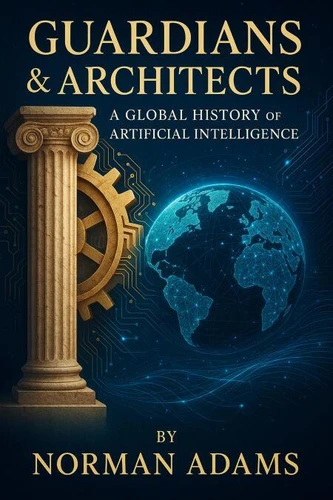
Guardians & Architects: A Global History of Artificial Intelligence How Ideas, Policy, and Power Shaped the Machine Age
Par :Formats :
Disponible dans votre compte client Decitre ou Furet du Nord dès validation de votre commande. Le format ePub est :
- Compatible avec une lecture sur My Vivlio (smartphone, tablette, ordinateur)
- Compatible avec une lecture sur liseuses Vivlio
- Pour les liseuses autres que Vivlio, vous devez utiliser le logiciel Adobe Digital Edition. Non compatible avec la lecture sur les liseuses Kindle, Remarkable et Sony
 , qui est-ce ?
Notre partenaire de plateforme de lecture numérique où vous retrouverez l'ensemble de vos ebooks gratuitement
Pour en savoir plus sur nos ebooks, consultez notre aide en ligne ici
C'est si simple ! Lisez votre ebook avec l'app Vivlio sur votre tablette, mobile ou ordinateur :

- FormatePub
- ISBN8231601387
- EAN9798231601387
- Date de parution27/10/2025
- Protection num.pas de protection
- Infos supplémentairesepub
- ÉditeurWalzone Press
Résumé
1. Origins: Thinking Machines Before ComputersJourney through the ancient roots of artificial intelligence, from Greek myths of Hephaestus forging mechanical servants to medieval Islamic automata like al-Jazari's programmable fountains. This chapter traces philosophical foundations in Aristotle's formal logic, Descartes' mind-body dualism, and Leibniz's calculus of reasoning. It culminates in Alan Turing's 1936 universal machine and his 1950 "Computing Machinery and Intelligence, " introducing the Turing Test as a behavioral benchmark for machine thought.
Explore how early debates on mechanized reasoning shaped modern AI, bridging myth, mathematics, and the dawn of computation. Perfect for readers curious about the deep historical currents that birthed the machine age.2. The Birth of a Field (1950s-1970s)Relive the explosive optimism of AI's founding era, ignited by the 1956 Dartmouth Conference where John McCarthy coined "artificial intelligence." Meet pioneers Marvin Minsky, Claude Shannon, and Nathaniel Rochester as they envision machines simulating every facet of human learning.
Discover symbolic AI breakthroughs: Newell and Simon's Logic Theorist proving theorems, General Problem Solver tackling diverse challenges, and Terry Winograd's SHRDLU mastering natural language in a virtual blocks world. Yet, as complexity outpaced capability, funding dried up, ushering in the first AI winter. This chapter captures the thrill of early triumphs and the sobering limits that tempered ambition, setting the stage for future resurgence.3.
Symbols, Rules, and the Expert Systems Era (1970s-1980s)Step into the pragmatic revival of AI through rule-based expert systems that brought intelligence into real-world organizations. Learn how "if-then" logic captured human expertise, powering Stanford's DENDRAL to identify organic molecules and MYCIN to diagnose infections with superhuman precision. Witness commercialization via Digital Equipment Corporation's XCON, saving millions in computer configuration.
Yet, knowledge acquisition bottlenecks and brittleness in uncertain environments exposed fatal flaws, plunging AI into a second winter. This chapter reveals how expert systems proved AI's practical value while exposing the need for adaptive, learning-based paradigms, paving the way for machine learning's rise.4. Military Uses, Dual-Use Dilemmas, and GeopoliticsExamine AI's transformative role in modern warfare, from intelligence analysis and logistics optimization to the specter of lethal autonomous weapon systems (LAWS).
This chapter dissects how AI enhances surveillance, command decisions, and cyber operations while raising ethical alarms over delegating life-and-death choices to machines. Explore the U. S.-China AI arms race, export controls on critical chips, and stalled UN efforts to regulate "killer robots." Case studies highlight risks of escalation, accidental conflict, and eroded human accountability. Essential for understanding how military AI reshapes global power dynamics and the urgent need for transparent, binding international norms.5.
Futures: Scenarios, Governance Proposals, and Global CooperationEnvision AI's unfolding destiny through two contrasting futures: one of diffused prosperity where automation liberates humanity for creativity, another of concentrated power deepening inequality and instability. This capstone chapter synthesizes governance strategies-international norms, treaties banning LAWS, interoperable safety standards-and actionable recommendations for policymakers, corporations, and civil society.
From STEM education and robot taxes to universal basic income and multi-stakeholder transparency, it charts pathways to equitable outcomes. Ending with a clarion call for global cooperation amid U. S.-China rivalry, this forward-looking synthesis empowers readers to shape an AI future that serves all humanity.
Explore how early debates on mechanized reasoning shaped modern AI, bridging myth, mathematics, and the dawn of computation. Perfect for readers curious about the deep historical currents that birthed the machine age.2. The Birth of a Field (1950s-1970s)Relive the explosive optimism of AI's founding era, ignited by the 1956 Dartmouth Conference where John McCarthy coined "artificial intelligence." Meet pioneers Marvin Minsky, Claude Shannon, and Nathaniel Rochester as they envision machines simulating every facet of human learning.
Discover symbolic AI breakthroughs: Newell and Simon's Logic Theorist proving theorems, General Problem Solver tackling diverse challenges, and Terry Winograd's SHRDLU mastering natural language in a virtual blocks world. Yet, as complexity outpaced capability, funding dried up, ushering in the first AI winter. This chapter captures the thrill of early triumphs and the sobering limits that tempered ambition, setting the stage for future resurgence.3.
Symbols, Rules, and the Expert Systems Era (1970s-1980s)Step into the pragmatic revival of AI through rule-based expert systems that brought intelligence into real-world organizations. Learn how "if-then" logic captured human expertise, powering Stanford's DENDRAL to identify organic molecules and MYCIN to diagnose infections with superhuman precision. Witness commercialization via Digital Equipment Corporation's XCON, saving millions in computer configuration.
Yet, knowledge acquisition bottlenecks and brittleness in uncertain environments exposed fatal flaws, plunging AI into a second winter. This chapter reveals how expert systems proved AI's practical value while exposing the need for adaptive, learning-based paradigms, paving the way for machine learning's rise.4. Military Uses, Dual-Use Dilemmas, and GeopoliticsExamine AI's transformative role in modern warfare, from intelligence analysis and logistics optimization to the specter of lethal autonomous weapon systems (LAWS).
This chapter dissects how AI enhances surveillance, command decisions, and cyber operations while raising ethical alarms over delegating life-and-death choices to machines. Explore the U. S.-China AI arms race, export controls on critical chips, and stalled UN efforts to regulate "killer robots." Case studies highlight risks of escalation, accidental conflict, and eroded human accountability. Essential for understanding how military AI reshapes global power dynamics and the urgent need for transparent, binding international norms.5.
Futures: Scenarios, Governance Proposals, and Global CooperationEnvision AI's unfolding destiny through two contrasting futures: one of diffused prosperity where automation liberates humanity for creativity, another of concentrated power deepening inequality and instability. This capstone chapter synthesizes governance strategies-international norms, treaties banning LAWS, interoperable safety standards-and actionable recommendations for policymakers, corporations, and civil society.
From STEM education and robot taxes to universal basic income and multi-stakeholder transparency, it charts pathways to equitable outcomes. Ending with a clarion call for global cooperation amid U. S.-China rivalry, this forward-looking synthesis empowers readers to shape an AI future that serves all humanity.