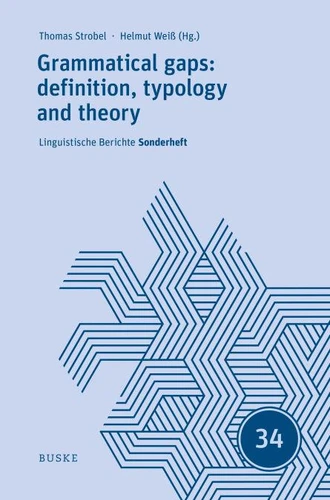
Grammatical gaps: definition, typology and theory
Par : , , , ,Formats :
Disponible dans votre compte client Decitre ou Furet du Nord dès validation de votre commande. Le format PDF est :
- Compatible avec une lecture sur My Vivlio (smartphone, tablette, ordinateur)
- Compatible avec une lecture sur liseuses Vivlio
- Pour les liseuses autres que Vivlio, vous devez utiliser le logiciel Adobe Digital Edition. Non compatible avec la lecture sur les liseuses Kindle, Remarkable et Sony
 , qui est-ce ?
Notre partenaire de plateforme de lecture numérique où vous retrouverez l'ensemble de vos ebooks gratuitement
Pour en savoir plus sur nos ebooks, consultez notre aide en ligne ici
C'est si simple ! Lisez votre ebook avec l'app Vivlio sur votre tablette, mobile ou ordinateur :

- Nombre de pages230
- FormatPDF
- ISBN978-3-96769-291-4
- EAN9783967692914
- Date de parution11/12/2023
- Protection num.Digital Watermarking
- Taille5 Mo
- Infos supplémentairespdf
- ÉditeurHelmut Buske Verlag
Résumé
Grammatiken sind (metaphorisch gesprochen) Anweisungen zum richtigen Gebrauch einer Sprache. Interessanterweise zeigen Grammatiken offenbar Lücken, die dadurch entstehen, dass für bestimmte Bereiche Regeln (bzw. Formen) ganz fehlen oder dass sich einzelne Regeln widersprechen und der daraus resultierende Konflikt deren Anwendung verhindert. Grammatische Lücken, auf deren Relevanz für eine 'realistische' Grammatiktheorie wohl zuerst Marga Reis hingewiesen hat, sind in den letzten Jahren schon vereinzelt in den Fokus der Forschung geraten.
Das Sonderheft versammelt Arbeiten zu verschiedenen Arten von Lücken und zeigt damit, wie ertragreich und wichtig die Erforschung grammatischer Lücken sein kann. Grammars are (metaphorically speaking) instructions for the correct use of languages. One might expect that grammars are complete, i.e., that they provide an appropriate solution for each utterance context. Interestingly, however, grammars seem to show gaps, which are caused by the fact that rules (or forms) in certain domains are missing completely or that individual rules contradict each other and that the resulting conflict prevents their application.
Grammatical gaps, whose relevance for a 'realistic' theory of grammar was probably first pointed out by Marga Reis, have come into the focus of research in recent years. The present special issue collects papers on different kinds of gaps and shows how fruitful and important the investigation of grammatical gaps can prove to be. Inhalt: Introduction - Ralf Vogel: Grammatical gaps, grammatical invention and grammatical theory - André Meinunger: Unexpected finite verb forms in German - cases of grammatical illusion? - Patrick Mächler, Anja Hasse: Gaps of definiteness.
Marking of (in)definiteness in Swiss German, Norwegian, Faroese and Elfdalian - Elisabeth Scherr: Attraction of the void. The lack of aspect in German and its effect on language change - Oliver Schallert: Morphological gaps in verbal diminutive formation: Some observations on Alemannic - Julia Bacskai-Atkari: Syntactic paradigms, markedness and similative markers in comparative and relative clauses - Fenna Bergsma: A typology of case competition in headless relatives - Ewa Trutkowski: How sex and gender shape agreement in German relative clauses - Tabea Reiner: What counts as a gap? The case of typological hierarchies
Das Sonderheft versammelt Arbeiten zu verschiedenen Arten von Lücken und zeigt damit, wie ertragreich und wichtig die Erforschung grammatischer Lücken sein kann. Grammars are (metaphorically speaking) instructions for the correct use of languages. One might expect that grammars are complete, i.e., that they provide an appropriate solution for each utterance context. Interestingly, however, grammars seem to show gaps, which are caused by the fact that rules (or forms) in certain domains are missing completely or that individual rules contradict each other and that the resulting conflict prevents their application.
Grammatical gaps, whose relevance for a 'realistic' theory of grammar was probably first pointed out by Marga Reis, have come into the focus of research in recent years. The present special issue collects papers on different kinds of gaps and shows how fruitful and important the investigation of grammatical gaps can prove to be. Inhalt: Introduction - Ralf Vogel: Grammatical gaps, grammatical invention and grammatical theory - André Meinunger: Unexpected finite verb forms in German - cases of grammatical illusion? - Patrick Mächler, Anja Hasse: Gaps of definiteness.
Marking of (in)definiteness in Swiss German, Norwegian, Faroese and Elfdalian - Elisabeth Scherr: Attraction of the void. The lack of aspect in German and its effect on language change - Oliver Schallert: Morphological gaps in verbal diminutive formation: Some observations on Alemannic - Julia Bacskai-Atkari: Syntactic paradigms, markedness and similative markers in comparative and relative clauses - Fenna Bergsma: A typology of case competition in headless relatives - Ewa Trutkowski: How sex and gender shape agreement in German relative clauses - Tabea Reiner: What counts as a gap? The case of typological hierarchies