
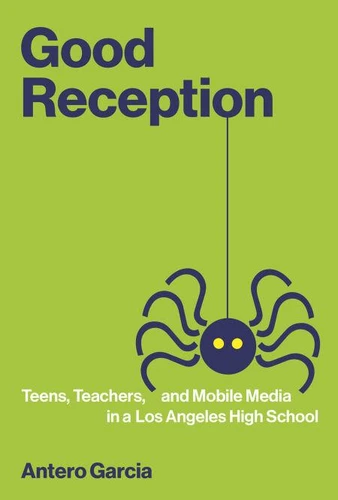
Good Reception. Teens, Teachers, and Mobile Media in a Los Angeles High School
Par :Formats :
Disponible dans votre compte client Decitre ou Furet du Nord dès validation de votre commande. Le format ePub protégé est :
- Compatible avec une lecture sur My Vivlio (smartphone, tablette, ordinateur)
- Compatible avec une lecture sur liseuses Vivlio
- Pour les liseuses autres que Vivlio, vous devez utiliser le logiciel Adobe Digital Edition. Non compatible avec la lecture sur les liseuses Kindle, Remarkable et Sony
- Non compatible avec un achat hors France métropolitaine
 , qui est-ce ?
Notre partenaire de plateforme de lecture numérique où vous retrouverez l'ensemble de vos ebooks gratuitement
Pour en savoir plus sur nos ebooks, consultez notre aide en ligne ici
C'est si simple ! Lisez votre ebook avec l'app Vivlio sur votre tablette, mobile ou ordinateur :

- Nombre de pages248
- FormatePub
- ISBN978-0-262-34349-7
- EAN9780262343497
- Date de parution10/11/2017
- Protection num.Adobe DRM
- Taille2 Mo
- Infos supplémentairesepub
- ÉditeurThe MIT Press
Résumé
A year in the life of a ninth-grade English class shows how participatory culture and mobile devices can transform learning in schools. Schools and school districts have one approach to innovation: buy more technology. In Good Reception, Antero Garcia describes what happens when educators build on the ways students already use technology outside of school to help them learn in the classroom. As a teacher in a public high school in South Central Los Angeles, Garcia watched his students' nearly universal adoption of mobile devices.
Whether recent immigrants from Central America or teens who had spent their entire lives in Los Angeles, the majority of his students relied on mobile devices to connect with family and friends and to keep up with complex social networks. Garcia determined to discover how these devices and student predilection for gameplay, combined with an evolving "culture of participation, " could be used in the classroom.
Garcia charts a year in the life of his ninth-grade English class, first surveying mobile media use on campus and then documenting a year-long experiment in creating a "wireless critical pedagogy" by incorporating mobile media and games in classroom work. He describes the design and implementation of "Ask Anansi, " an alternate reality game that allows students to conduct inquiry-based research around questions that interest them (including "Why is the food at South Central High School so bad?").
Garcia cautions that the transformative effect on education depends not on the glorification of devices but on teacher support and a trusting teacher-student relationship.
Whether recent immigrants from Central America or teens who had spent their entire lives in Los Angeles, the majority of his students relied on mobile devices to connect with family and friends and to keep up with complex social networks. Garcia determined to discover how these devices and student predilection for gameplay, combined with an evolving "culture of participation, " could be used in the classroom.
Garcia charts a year in the life of his ninth-grade English class, first surveying mobile media use on campus and then documenting a year-long experiment in creating a "wireless critical pedagogy" by incorporating mobile media and games in classroom work. He describes the design and implementation of "Ask Anansi, " an alternate reality game that allows students to conduct inquiry-based research around questions that interest them (including "Why is the food at South Central High School so bad?").
Garcia cautions that the transformative effect on education depends not on the glorification of devices but on teacher support and a trusting teacher-student relationship.
A propos de Antero Garcia

Annotation
E-book
15,65 €