SOLDES
Jusqu'à -70% sur une sélection d'articles*

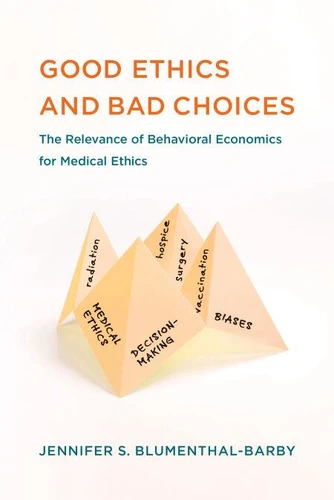
Good Ethics and Bad Choices. The Relevance of Behavioral Economics for Medical Ethics
Par :Formats :
Disponible dans votre compte client Decitre ou Furet du Nord dès validation de votre commande. Le format ePub protégé est :
- Compatible avec une lecture sur My Vivlio (smartphone, tablette, ordinateur)
- Compatible avec une lecture sur liseuses Vivlio
- Pour les liseuses autres que Vivlio, vous devez utiliser le logiciel Adobe Digital Edition. Non compatible avec la lecture sur les liseuses Kindle, Remarkable et Sony
- Non compatible avec un achat hors France métropolitaine
 , qui est-ce ?
Notre partenaire de plateforme de lecture numérique où vous retrouverez l'ensemble de vos ebooks gratuitement
Pour en savoir plus sur nos ebooks, consultez notre aide en ligne ici
C'est si simple ! Lisez votre ebook avec l'app Vivlio sur votre tablette, mobile ou ordinateur :

- Nombre de pages264
- FormatePub
- ISBN978-0-262-36530-7
- EAN9780262365307
- Date de parution03/08/2021
- Protection num.Adobe DRM
- Taille1 Mo
- Infos supplémentairesepub
- ÉditeurThe MIT Press
Résumé
An analysis of how findings in behavioral economics challenge fundamental assumptions of medical ethics, integrating the latest research in both fields. Bioethicists have long argued for rational persuasion to help patients with medical decisions. But the findings of behavioral economics-popularized in Thaler and Sunstein's Nudge and other books-show that arguments depending on rational thinking are unlikely to be successful and even that the idea of purely rational persuasion may be a fiction.
In Good Ethics and Bad Choices, Jennifer Blumenthal-Barby examines how behavioral economics challenges some of the most fundamental tenets of medical ethics. She not only integrates the latest research from both fields but also provides examples of how physicians apply concepts of behavioral economics in practice. Blumenthal-Barby analyzes ethical issues raised by "nudging" patient decision making and argues that the practice can improve patient decisions, prevent harm, and perhaps enhance autonomy.
She then offers a more detailed ethical analysis of further questions that arise, including whether nudging amounts to manipulation, to what extent and at what point these techniques should be used, when and how their use would be wrong, and whether transparency about their use is required. She provides a snapshot of nudging "in the weeds, " reporting on practices she observed in clinical settings including psychiatry, pediatric critical care, and oncology.
Warning that there is no "single, simple account of the ethics of nudging, " Blumenthal-Barby offers a qualified defense, arguing that a nudge can be justified in part by the extent to which it makes patients better off.
In Good Ethics and Bad Choices, Jennifer Blumenthal-Barby examines how behavioral economics challenges some of the most fundamental tenets of medical ethics. She not only integrates the latest research from both fields but also provides examples of how physicians apply concepts of behavioral economics in practice. Blumenthal-Barby analyzes ethical issues raised by "nudging" patient decision making and argues that the practice can improve patient decisions, prevent harm, and perhaps enhance autonomy.
She then offers a more detailed ethical analysis of further questions that arise, including whether nudging amounts to manipulation, to what extent and at what point these techniques should be used, when and how their use would be wrong, and whether transparency about their use is required. She provides a snapshot of nudging "in the weeds, " reporting on practices she observed in clinical settings including psychiatry, pediatric critical care, and oncology.
Warning that there is no "single, simple account of the ethics of nudging, " Blumenthal-Barby offers a qualified defense, arguing that a nudge can be justified in part by the extent to which it makes patients better off.