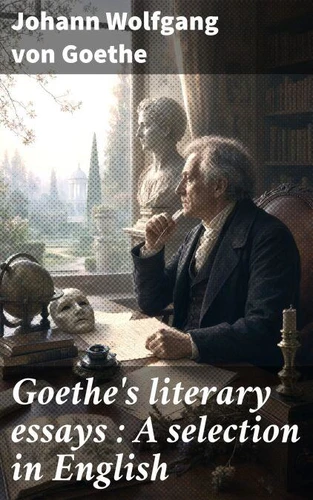
Goethe's Literary Essays: A Selection in English gathers a representative body of reflections on poetry, drama, art, criticism, and world literature by one of Europe's defining intellectuals. The volume reveals Goethe not merely as a creative genius but as a disciplined theorist of form, culture, and aesthetic judgment. Across essays of remarkable clarity and range, readers encounter his mature classicism, his engagement with Shakespeare, antiquity, and comparative literature, and his effort to reconcile artistic freedom with organic order.
In English translation, the collection illuminates the intellectual milieu of Weimar Classicism and the broader transformation of European literary thought. Johann Wolfgang von Goethe (1749-1832) was at once poet, dramatist, novelist, statesman, and natural philosopher, and these multiple vocations deeply inform the essays. His long career, extending from the Sturm und Drang period to the high achievements of Weimar, gave him an unmatched vantage on literary change.
His friendships with Schiller and his lifelong study of art, science, and classical antiquity shaped the reflective, synthetic cast of these writings. This volume is especially recommended to readers seeking Goethe beyond Faust or Werther. It offers scholars, students, and serious general readers a concise yet profound entry into his critical mind and into the foundations of modern literary thought.
Goethe's Literary Essays: A Selection in English gathers a representative body of reflections on poetry, drama, art, criticism, and world literature by one of Europe's defining intellectuals. The volume reveals Goethe not merely as a creative genius but as a disciplined theorist of form, culture, and aesthetic judgment. Across essays of remarkable clarity and range, readers encounter his mature classicism, his engagement with Shakespeare, antiquity, and comparative literature, and his effort to reconcile artistic freedom with organic order.
In English translation, the collection illuminates the intellectual milieu of Weimar Classicism and the broader transformation of European literary thought. Johann Wolfgang von Goethe (1749-1832) was at once poet, dramatist, novelist, statesman, and natural philosopher, and these multiple vocations deeply inform the essays. His long career, extending from the Sturm und Drang period to the high achievements of Weimar, gave him an unmatched vantage on literary change.
His friendships with Schiller and his lifelong study of art, science, and classical antiquity shaped the reflective, synthetic cast of these writings. This volume is especially recommended to readers seeking Goethe beyond Faust or Werther. It offers scholars, students, and serious general readers a concise yet profound entry into his critical mind and into the foundations of modern literary thought.

 , qui est-ce ?