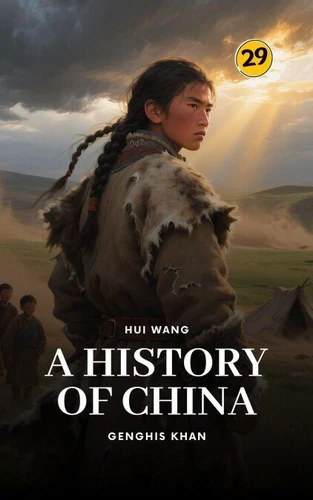
Genghis Khan: A History of China. A History of China, #29
Par :Formats :
Disponible dans votre compte client Decitre ou Furet du Nord dès validation de votre commande. Le format ePub est :
- Compatible avec une lecture sur My Vivlio (smartphone, tablette, ordinateur)
- Compatible avec une lecture sur liseuses Vivlio
- Pour les liseuses autres que Vivlio, vous devez utiliser le logiciel Adobe Digital Edition. Non compatible avec la lecture sur les liseuses Kindle, Remarkable et Sony
 , qui est-ce ?
Notre partenaire de plateforme de lecture numérique où vous retrouverez l'ensemble de vos ebooks gratuitement
Pour en savoir plus sur nos ebooks, consultez notre aide en ligne ici
C'est si simple ! Lisez votre ebook avec l'app Vivlio sur votre tablette, mobile ou ordinateur :

- FormatePub
- ISBN978-91-89998-86-5
- EAN9789189998865
- Date de parution24/08/2025
- Protection num.pas de protection
- Infos supplémentairesepub
- ÉditeurHui Wang
Résumé
Genghis Khan: A History of China, PART ONE, carries you out across the endless grasslands where legends were forged and the fate of empires was decided. Long before the world learned the name Genghis Khan, the Mongol tribes lived and died by the bow and the horse. This tale opens with the sacred Birth of the Golden Lineage, when the ancestors of Temüjin first rode beneath the vast Mongolian sky. You will meet Khabul Khan battling the mighty Jurchen Jin Dynasty, and you will hear the echo of Ambaghai's tragic fate and Hotula Khan's fierce vow-oaths of vengeance and honor that shaped generations to come.
From there the narrative follows the Birth of Temüjin, the boy who would rise from hardship and exile to lead a nation. Under the fierce, watchful protection of his mother Hoelun, he learns strength not from comfort but from survival. In The Orphan of the Steppe and Under the Banner of Hoelun, every hardship-hunger, betrayal, capture-becomes a lesson that steels his spirit. When he finally breaks free in The Escape from the Taichi'ud and wins his first reward in The Black Sable Coat, the reader can feel, in each small victory and scar, the making of a future khan.
As the young Temüjin gathers his loyal brothers and sworn allies, his First War gives him the first sharp taste of command. But friendship on the steppe is brittle; the bonds sealed in blood can splinter under ambition. In "Temüjin and Jamukha" and in the chapter I call "Brothers at War, " we watch two once-anda companions become rivals whose struggle will shake tribes from the Onon River to the Gobi.
Their oath, once a symbol of unity, hardens into a clash between two visions of leadership-one forged by collective loyalty and merit, the other by lineage and pride. The strain only deepens in what I call the Second War with Jamukha and in "The Betrayal of the Father Khan, " when the old alliance with Wang Khan (Toghrul) begins to crumble. Into that turmoil rides Jebe-called the Arrow-whose daring and fidelity will pass into legend.
Through their eyes we see Temüjin transform disorder into order, inventing discipline from the chaos and turning scattered riders into an army that fights as one. The saga swells to the fall of the Tatars - a turning point where vengeance and destiny collide. Every name-Ambaghai, Hotula, Hoelun, Jamukha, Wang Khan (Toghrul), Jebe-marks a chapter along the long road that turned a hunted boy into master of the steppe.
From there the narrative follows the Birth of Temüjin, the boy who would rise from hardship and exile to lead a nation. Under the fierce, watchful protection of his mother Hoelun, he learns strength not from comfort but from survival. In The Orphan of the Steppe and Under the Banner of Hoelun, every hardship-hunger, betrayal, capture-becomes a lesson that steels his spirit. When he finally breaks free in The Escape from the Taichi'ud and wins his first reward in The Black Sable Coat, the reader can feel, in each small victory and scar, the making of a future khan.
As the young Temüjin gathers his loyal brothers and sworn allies, his First War gives him the first sharp taste of command. But friendship on the steppe is brittle; the bonds sealed in blood can splinter under ambition. In "Temüjin and Jamukha" and in the chapter I call "Brothers at War, " we watch two once-anda companions become rivals whose struggle will shake tribes from the Onon River to the Gobi.
Their oath, once a symbol of unity, hardens into a clash between two visions of leadership-one forged by collective loyalty and merit, the other by lineage and pride. The strain only deepens in what I call the Second War with Jamukha and in "The Betrayal of the Father Khan, " when the old alliance with Wang Khan (Toghrul) begins to crumble. Into that turmoil rides Jebe-called the Arrow-whose daring and fidelity will pass into legend.
Through their eyes we see Temüjin transform disorder into order, inventing discipline from the chaos and turning scattered riders into an army that fights as one. The saga swells to the fall of the Tatars - a turning point where vengeance and destiny collide. Every name-Ambaghai, Hotula, Hoelun, Jamukha, Wang Khan (Toghrul), Jebe-marks a chapter along the long road that turned a hunted boy into master of the steppe.