
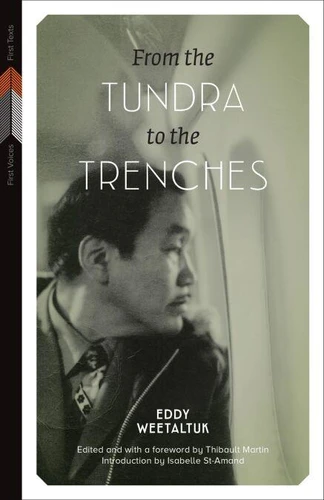
Eddy Weetaltuk (1932 to 2005), was born on Strutton Island, James Bay.
He enlisted in the Canadian Army and served in Korea. He left the army
in 1967 and was stationed in Germany for many years.
Thibault Martin is a professor of Sociology at the Université du Québec en Outaouais and is the author of De la banquise au congélateur: mondialisation et culture au Nunavik.
Isabelle St-Amand is a SSHRC Postdoctoral Fellow affiliated with the
Department of Native Studies, University of Manitoba.
From the Tundra to the Trenches
Par : , ,Formats :
Disponible dans votre compte client Decitre ou Furet du Nord dès validation de votre commande. Le format ePub est :
- Compatible avec une lecture sur My Vivlio (smartphone, tablette, ordinateur)
- Compatible avec une lecture sur liseuses Vivlio
- Pour les liseuses autres que Vivlio, vous devez utiliser le logiciel Adobe Digital Edition. Non compatible avec la lecture sur les liseuses Kindle, Remarkable et Sony
 , qui est-ce ?
Notre partenaire de plateforme de lecture numérique où vous retrouverez l'ensemble de vos ebooks gratuitement
Pour en savoir plus sur nos ebooks, consultez notre aide en ligne ici
C'est si simple ! Lisez votre ebook avec l'app Vivlio sur votre tablette, mobile ou ordinateur :

- Nombre de pages279
- FormatePub
- ISBN978-0-88755-534-3
- EAN9780887555343
- Date de parution03/02/2017
- Protection num.Digital Watermarking
- Taille7 Mo
- Infos supplémentairesepub
- ÉditeurUniversity of Manitoba Press
Résumé
"My name is Weetaltuk; Eddy Weetaltuk. My Eskimo tag name is E9-422." So begins From the Tundra to the Trenches. Weetaltuk means "innocent eyes" in Inuktitut, but to the Canadian government, he was known as E9-422: E for Eskimo, 9 for his community, 422 to identify Eddy.
In 1951, Eddy decided to leave James Bay. Because Inuit weren't allowed to leave the North, he changed his name and used this new identity to enlist in the Canadian Forces: Edward Weetaltuk, E9-422, became Eddy Vital, SC-17515, and headed off to fight in the Korean War.
In 1967, after fifteen years in the Canadian Forces, Eddy returned home. He worked with Inuit youth struggling with drug and alcohol addiction, and, in 1974, started writing his life's story. This compelling memoir traces an Inuk's experiences of world travel and military service. Looking back on his life, Weetaltuk wanted to show young Inuit that they can do and be what they choose. From the Tundra to the Trenches is the fourth book in the First Voices, First Texts series, which publishes lost or underappreciated texts by Indigenous writers.
This new English edition of Eddy Weetaltuk's memoir includes a foreword and appendix by Thibault Martin and an introduction by Isabelle St-Amand.
In 1967, after fifteen years in the Canadian Forces, Eddy returned home. He worked with Inuit youth struggling with drug and alcohol addiction, and, in 1974, started writing his life's story. This compelling memoir traces an Inuk's experiences of world travel and military service. Looking back on his life, Weetaltuk wanted to show young Inuit that they can do and be what they choose. From the Tundra to the Trenches is the fourth book in the First Voices, First Texts series, which publishes lost or underappreciated texts by Indigenous writers.
This new English edition of Eddy Weetaltuk's memoir includes a foreword and appendix by Thibault Martin and an introduction by Isabelle St-Amand.
A propos de Eddy Weetaltuk
14,99 €