
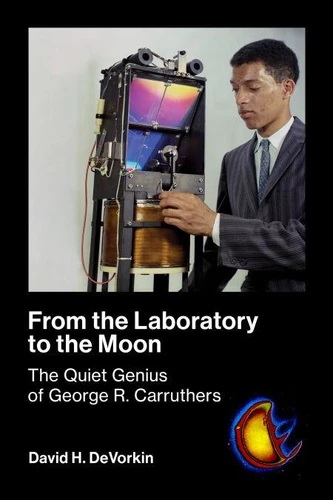
From the Laboratory to the Moon. The Quiet Genius of George R. Carruthers
Par :Formats :
Disponible dans votre compte client Decitre ou Furet du Nord dès validation de votre commande. Le format ePub protégé est :
- Compatible avec une lecture sur My Vivlio (smartphone, tablette, ordinateur)
- Compatible avec une lecture sur liseuses Vivlio
- Pour les liseuses autres que Vivlio, vous devez utiliser le logiciel Adobe Digital Edition. Non compatible avec la lecture sur les liseuses Kindle, Remarkable et Sony
- Non compatible avec un achat hors France métropolitaine
 , qui est-ce ?
Notre partenaire de plateforme de lecture numérique où vous retrouverez l'ensemble de vos ebooks gratuitement
Pour en savoir plus sur nos ebooks, consultez notre aide en ligne ici
C'est si simple ! Lisez votre ebook avec l'app Vivlio sur votre tablette, mobile ou ordinateur :

- Nombre de pages456
- FormatePub
- ISBN978-0-262-38180-2
- EAN9780262381802
- Date de parution20/05/2025
- Protection num.Adobe DRM
- Taille47 Mo
- Infos supplémentairesepub
- ÉditeurThe MIT Press
Résumé
The reserved genius and celebrated Black scientist, who built the first astronomical observatory on the moon and worked to inspire underserved students to pursue science and engineering. In April 1972, as George Carruthers closely monitored the operation from the Manned Spacecraft Center in Houston, astronauts conducting the Apollo 16 mission positioned a gold-plated far ultraviolet electrographic camera on the moon.
The camera, Carruthers's invention, was the first astronomical observatory on the lunar surface, where it stands to this day. While Carruthers's achievements earned many accolades, including the President's Medal for Technology and Invention, surprisingly little is known about this remarkable man. In From the Laboratory to the Moon, David DeVorkin explores Carruthers's life and work, for the first time telling the full story of how a deeply reserved African American farm boy rose to become one of our most celebrated aerospace scientists.
DeVorkin follows Carruthers from his childhood in Ohio and then Chicago to his career at the US Naval Research Laboratory in Washington, DC. In the highly competitive world of space science in the 1960s and 1970s, Carruthers's genius for experimentation and exploration transcended the racial stereotyping and discrimination of his day, and he achieved world-class recognition for his studies of the Earth and deep space.
A leading expert in the history of astronomy and space science, DeVorkin gives a deft account of these achievements and of how Carruthers used the fame they brought him, along with his notoriety as a Black man in science, to become a tireless advocate for underserved young people in science and engineering.
The camera, Carruthers's invention, was the first astronomical observatory on the lunar surface, where it stands to this day. While Carruthers's achievements earned many accolades, including the President's Medal for Technology and Invention, surprisingly little is known about this remarkable man. In From the Laboratory to the Moon, David DeVorkin explores Carruthers's life and work, for the first time telling the full story of how a deeply reserved African American farm boy rose to become one of our most celebrated aerospace scientists.
DeVorkin follows Carruthers from his childhood in Ohio and then Chicago to his career at the US Naval Research Laboratory in Washington, DC. In the highly competitive world of space science in the 1960s and 1970s, Carruthers's genius for experimentation and exploration transcended the racial stereotyping and discrimination of his day, and he achieved world-class recognition for his studies of the Earth and deep space.
A leading expert in the history of astronomy and space science, DeVorkin gives a deft account of these achievements and of how Carruthers used the fame they brought him, along with his notoriety as a Black man in science, to become a tireless advocate for underserved young people in science and engineering.