
Peter Berger is Associate Professor of Indian Religions and the Anthropology of Religion at the University of Groningen. His books include Feeding, Sharing and Devouring: Ritual and Society in Highland Odisha (de Gruyter, 2014) and The Modern Anthropology of India (co-ed with Frank Heidemann, Routledge, 2013).
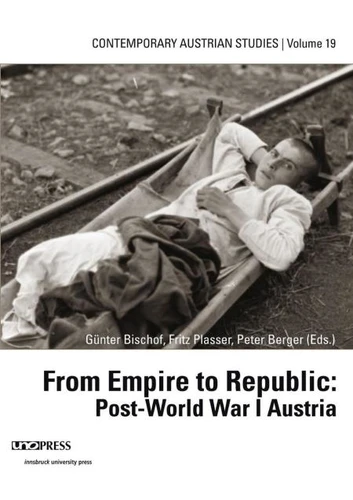
From Empire to Republic. Post-World War I Austria
Par : , ,Formats :
Disponible dans votre compte client Decitre ou Furet du Nord dès validation de votre commande. Le format Multi-format est :
- Pour les liseuses autres que Vivlio, vous devez utiliser le logiciel Adobe Digital Edition. Non compatible avec la lecture sur les liseuses Kindle, Remarkable et Sony
 , qui est-ce ?
Notre partenaire de plateforme de lecture numérique où vous retrouverez l'ensemble de vos ebooks gratuitement
Pour en savoir plus sur nos ebooks, consultez notre aide en ligne ici
C'est si simple ! Lisez votre ebook avec l'app Vivlio sur votre tablette, mobile ou ordinateur :

- Nombre de pages448
- FormatMulti-format
- ISBN978-3-903122-39-0
- EAN9783903122390
- Date de parution29/09/2016
- Protection num.NC
- Infos supplémentairesMulti-Format
- Éditeurinnsbruck university press
Résumé
After the dissolution of the Austro-Hungarian Monarchy, Austria transformed itself from an empire to a small Central European country. Formerly an important player in international affairs, the new republic was quickly sidelined by the European concert of powers. The enormous losses of territory and population in Austria's post-Habsburg state of existence, however, did not result in a political, economic, cultural, and intellectual black hole.
The essays in the twentieth anniversary volume of Contemporary Austrian Studies argue that the small Austrian nation found its place in the global arena of the twentieth century and made a mark both on Europe and the world. Be it Freudian psychoanalysis, the "fin-de-siècle" Vienna culture of modernism, Austro-Marxist thought, or the Austrian School of Economics, Austrian hinkers and ideas were still wielding a notable impact on the world.
Alongside these cultural and intellectual dimensions, Vienna remained the Austrian capital and reasserted its strong position in Central European and international business and finance. Innovative Austrian companies are operating all over the globe. This volume also examines how the globalizing world of the twentieth century has impacted Austrian demography, society, and political life. Austria's place in the contemporary world is increasingly determined by the forces of the European integration process.
European Union membership brings about convergence and a regional orientation with ramifications for Austria's global role. Austria emerges in the essays of this volume as a highly globalized country with an economy, society, and political culture deeply grounded in Europe. The globalization of Austria, it appears, turns out to be in many instances an "Europeanization".
The essays in the twentieth anniversary volume of Contemporary Austrian Studies argue that the small Austrian nation found its place in the global arena of the twentieth century and made a mark both on Europe and the world. Be it Freudian psychoanalysis, the "fin-de-siècle" Vienna culture of modernism, Austro-Marxist thought, or the Austrian School of Economics, Austrian hinkers and ideas were still wielding a notable impact on the world.
Alongside these cultural and intellectual dimensions, Vienna remained the Austrian capital and reasserted its strong position in Central European and international business and finance. Innovative Austrian companies are operating all over the globe. This volume also examines how the globalizing world of the twentieth century has impacted Austrian demography, society, and political life. Austria's place in the contemporary world is increasingly determined by the forces of the European integration process.
European Union membership brings about convergence and a regional orientation with ramifications for Austria's global role. Austria emerges in the essays of this volume as a highly globalized country with an economy, society, and political culture deeply grounded in Europe. The globalization of Austria, it appears, turns out to be in many instances an "Europeanization".
A propos de Peter Berger
18,00 €
La construction sociale de la réalité
Grand Format
25,90 €