SOLDES
Jusqu'à -70% sur une sélection d'articles*

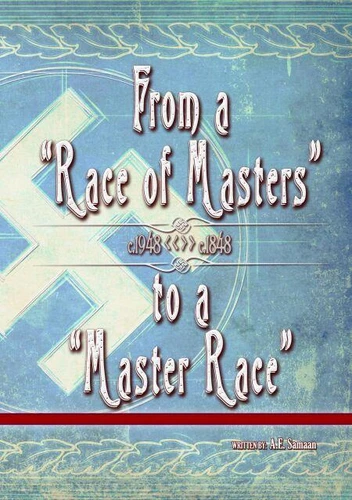
From a "Race of Masters" to a "Master Race": 1948 to 1848. Eugenics Anthology, #1
Par :Formats :
Disponible dans votre compte client Decitre ou Furet du Nord dès validation de votre commande. Le format ePub est :
- Compatible avec une lecture sur My Vivlio (smartphone, tablette, ordinateur)
- Compatible avec une lecture sur liseuses Vivlio
- Pour les liseuses autres que Vivlio, vous devez utiliser le logiciel Adobe Digital Edition. Non compatible avec la lecture sur les liseuses Kindle, Remarkable et Sony
 , qui est-ce ?
Notre partenaire de plateforme de lecture numérique où vous retrouverez l'ensemble de vos ebooks gratuitement
Pour en savoir plus sur nos ebooks, consultez notre aide en ligne ici
C'est si simple ! Lisez votre ebook avec l'app Vivlio sur votre tablette, mobile ou ordinateur :

- FormatePub
- ISBN978-1-393-55686-2
- EAN9781393556862
- Date de parution09/11/2020
- Protection num.pas de protection
- Infos supplémentairesepub
- ÉditeurRelay Publishing
Résumé
From a "Race of Masters" to a "Master Race": 1948 to 1848Vol. 1 - The Eugenics AnthologyNazism remains an enigma. Historians do not know whether to slot Nazism as a phenomenon of the political "right" or "left, " largely because of a misunderstanding of how central eugenics was to the regime. Eugenics, or "racial hygiene, " was at the core of National Socialism's domestic policy, foreign policy, culture wars, and even Hitler's obsession with cars, highways, and city planning.
Thus, no coherent understanding of the regime is possible without first grasping the nature of eugenics. Eugenics did not originate with Nazi Germany. It was the culmination of a worldwide movement that was widely accepted by the global scientific and academic community. This book traces the origins of the Nazi eugenics state, working backward down the timeline, tracing from leaf down to the root.
We investigate this 100-year trajectory from its beginnings in British and American Academia, delving into the conveniently forgotten inner-workings of a scientific era, uncovering previously unpublished manuscripts, professional correspondence, and conveniently forgotten publications. With the centenary of The Holocaust looming, uprooting the web of professional connections that engendered this movement is in order.
The seeds of Holocaust denial take root and prosper with misinformation. Clarity and transparency are imperative, as they leave no room for denial theories that would deprive the victims of justice, or rob the living of a future. AUTHOR'S NOTE:A preliminary version of this book was circulated amongst academic circles and other interested parties as an Advanced Readers Copy (A. R. C.) in 2015. This version is a part the Eugenics Anthology seven-book series that is currently being completed by A.
E. Samaan. THIS BOOK SERIES IS BASED ON ONGOING ORIGINAL RESEARCH FROM THE FOLLOWING ARCHIVES: Truman State University, MO - Pickler Memorial Library - Special Collections - Harry Hamilton Laughlin. American Philosophical Society, PA - Genetics and Eugenics Collection. California Institute of Technology, CA - Register of the E. S. Gosney Papers. Cold Spring Harbor Laboratory Library, Cold Spring Harbor, NY.
Carnegie Institution of Washington, D. C. - Eugenics Records Office Files. Columbia University, NY - Rare Book & Manuscripts, Butler Library -Telford Taylor Papers. United States National Archives, Washington D. C. - Records About the Holocaust and War Crimes. University of Iowa - Charles F. Wennerstrum Papers. United States Library of Congress, Washington D. C. - Robert H. Jackson Papers. The Margaret Sanger Papers Project.
Chicago Tribune Archives. New York Times Article Archive. PERSONAL CONVERSATIONS AS PRIMARY SOURCES: Ken Gemes, Birkbeck University of London Garland Allen, Washington University of St. Louis Professor Jonathan Marks, University of North Carolina Paul Lombardo, Regents' Professor and Bobby Lee Cook Professor of Law in the Center for Law Health and Society at Georgia State University Stefan Kühl, Professor of Sociology at the Faculty of Sociology of the University of Bielefeld.
Thus, no coherent understanding of the regime is possible without first grasping the nature of eugenics. Eugenics did not originate with Nazi Germany. It was the culmination of a worldwide movement that was widely accepted by the global scientific and academic community. This book traces the origins of the Nazi eugenics state, working backward down the timeline, tracing from leaf down to the root.
We investigate this 100-year trajectory from its beginnings in British and American Academia, delving into the conveniently forgotten inner-workings of a scientific era, uncovering previously unpublished manuscripts, professional correspondence, and conveniently forgotten publications. With the centenary of The Holocaust looming, uprooting the web of professional connections that engendered this movement is in order.
The seeds of Holocaust denial take root and prosper with misinformation. Clarity and transparency are imperative, as they leave no room for denial theories that would deprive the victims of justice, or rob the living of a future. AUTHOR'S NOTE:A preliminary version of this book was circulated amongst academic circles and other interested parties as an Advanced Readers Copy (A. R. C.) in 2015. This version is a part the Eugenics Anthology seven-book series that is currently being completed by A.
E. Samaan. THIS BOOK SERIES IS BASED ON ONGOING ORIGINAL RESEARCH FROM THE FOLLOWING ARCHIVES: Truman State University, MO - Pickler Memorial Library - Special Collections - Harry Hamilton Laughlin. American Philosophical Society, PA - Genetics and Eugenics Collection. California Institute of Technology, CA - Register of the E. S. Gosney Papers. Cold Spring Harbor Laboratory Library, Cold Spring Harbor, NY.
Carnegie Institution of Washington, D. C. - Eugenics Records Office Files. Columbia University, NY - Rare Book & Manuscripts, Butler Library -Telford Taylor Papers. United States National Archives, Washington D. C. - Records About the Holocaust and War Crimes. University of Iowa - Charles F. Wennerstrum Papers. United States Library of Congress, Washington D. C. - Robert H. Jackson Papers. The Margaret Sanger Papers Project.
Chicago Tribune Archives. New York Times Article Archive. PERSONAL CONVERSATIONS AS PRIMARY SOURCES: Ken Gemes, Birkbeck University of London Garland Allen, Washington University of St. Louis Professor Jonathan Marks, University of North Carolina Paul Lombardo, Regents' Professor and Bobby Lee Cook Professor of Law in the Center for Law Health and Society at Georgia State University Stefan Kühl, Professor of Sociology at the Faculty of Sociology of the University of Bielefeld.