
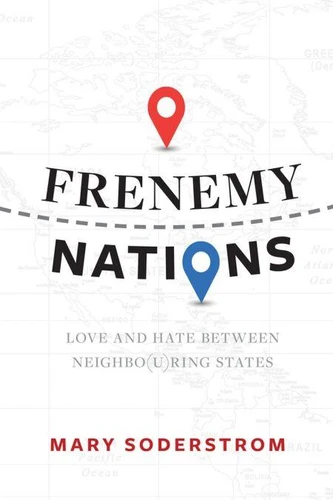
Mary Soderstrom has come far from her birthplace of Walla Walla, Washington. A world traveller, Soderstrom is now a Canadian and Montrealer. She is also the award-winning author of more than a dozen fiction and non-fiction books, including her acclaimed Road Through Time: The Story of Humanity on the Move, and most recently, Frenemy Nations: Love and Hate between Neighbo(u)ring States.
Frenemy Nations. Love and Hate Between Neighbo(u)ring States
Par :Formats :
Disponible dans votre compte client Decitre ou Furet du Nord dès validation de votre commande. Le format ePub est :
- Compatible avec une lecture sur My Vivlio (smartphone, tablette, ordinateur)
- Compatible avec une lecture sur liseuses Vivlio
- Pour les liseuses autres que Vivlio, vous devez utiliser le logiciel Adobe Digital Edition. Non compatible avec la lecture sur les liseuses Kindle, Remarkable et Sony
 , qui est-ce ?
Notre partenaire de plateforme de lecture numérique où vous retrouverez l'ensemble de vos ebooks gratuitement
Pour en savoir plus sur nos ebooks, consultez notre aide en ligne ici
C'est si simple ! Lisez votre ebook avec l'app Vivlio sur votre tablette, mobile ou ordinateur :

- Nombre de pages276
- FormatePub
- ISBN978-0-88977-674-6
- EAN9780889776746
- Date de parution26/10/2019
- Protection num.Digital Watermarking
- Taille4 Mo
- Infos supplémentairesepub
- ÉditeurUniversity of Regina Press
Résumé
An in-depth look at places-nation-states, states, and provinces-that are geographically side-by-side but otherwise, worlds apart.
In the summer of 1968, Mary Soderstrom and her husband loaded up their VW Beetle and immigrated to Canada from the United States. The contrast between their new home and their old led to a long-running reflection on what makes the two countries different. How could two places that are similar in so many ways be so disparate in others?
In Frenemy Nations, Soderstrom answers this question by addressing a range of geographical "odd couples": including the United States and Canada; New Hampshire and Vermont; Alberta and Saskatchewan; Haiti and the Dominican Republic; Scotland and Ireland; Rwanda and Burundi; and more.
Through it all, Soderstrom shows how tiny differences-in geographic features, colonial histories, resource competition, education, women's roles, language, and migration-can have outsized effects on how polities develop.
Through it all, Soderstrom shows how tiny differences-in geographic features, colonial histories, resource competition, education, women's roles, language, and migration-can have outsized effects on how polities develop.