SOLDES
Jusqu'à -70% sur une sélection d'articles*

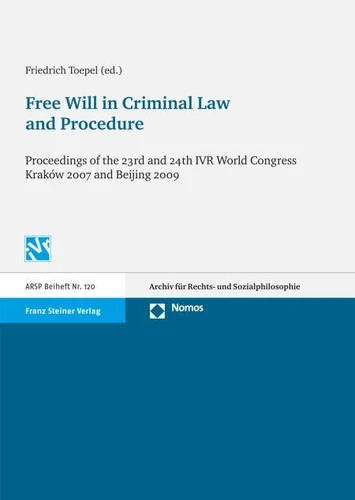
Free Will in Criminal Law and Procedure. Proceedings of the 23rd and 24th World Congress of the International Association for Philosophy of Law an Social Philosophy Kraków 2007 and Beijing 2009
Par :Formats :
Disponible dans votre compte client Decitre ou Furet du Nord dès validation de votre commande. Le format PDF est :
- Compatible avec une lecture sur My Vivlio (smartphone, tablette, ordinateur)
- Compatible avec une lecture sur liseuses Vivlio
- Pour les liseuses autres que Vivlio, vous devez utiliser le logiciel Adobe Digital Edition. Non compatible avec la lecture sur les liseuses Kindle, Remarkable et Sony
 , qui est-ce ?
Notre partenaire de plateforme de lecture numérique où vous retrouverez l'ensemble de vos ebooks gratuitement
Pour en savoir plus sur nos ebooks, consultez notre aide en ligne ici
C'est si simple ! Lisez votre ebook avec l'app Vivlio sur votre tablette, mobile ou ordinateur :

- Nombre de pages122
- FormatPDF
- ISBN978-3-515-09984-4
- EAN9783515099844
- Date de parution10/09/2012
- Protection num.Digital Watermarking
- Taille724 Ko
- Infos supplémentairespdf
- ÉditeurFranz Steiner
Résumé
This supplement to the Archives for Philosophy of Law and Social Philosophy (ARSP) covers all of the fundamental aspects of the free will problem, concentrating on questions of criminal and procedural law. In the first section the concept of free will is analyzed and the deterministic approach of Ronald J. Allen is discussed as laid out in his essay "Miranda's Hollow Core" in the Northwestern Law Review.
The section is concluded by Professor Allen's reply to his critics. Professor Allen's determinism stands in contrast to the libertarianism of David Hodgson and Friedrich Toepel. The essays of Allan McCay and Juan Pablo Mañalich concentrate on compatibilistic theories. The second section focuses on a critical analysis of compatibilism. In this context, Angus Menuge also discusses the question of concrete evidence for a free will.
Friedrich Toepel examines the relevance of alternative models, and Mateusz Klinowski argues that many of the relevant questions can already be answered by applying logical principles. In both sections, John W. Montgomery also provides rare insights into the theological background of the topic.
The section is concluded by Professor Allen's reply to his critics. Professor Allen's determinism stands in contrast to the libertarianism of David Hodgson and Friedrich Toepel. The essays of Allan McCay and Juan Pablo Mañalich concentrate on compatibilistic theories. The second section focuses on a critical analysis of compatibilism. In this context, Angus Menuge also discusses the question of concrete evidence for a free will.
Friedrich Toepel examines the relevance of alternative models, and Mateusz Klinowski argues that many of the relevant questions can already be answered by applying logical principles. In both sections, John W. Montgomery also provides rare insights into the theological background of the topic.