
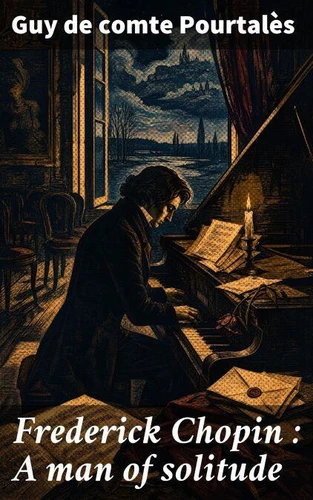
Frederick Chopin : A man of solitude
Par : ,Formats :
Disponible dans votre compte client Decitre ou Furet du Nord dès validation de votre commande. Le format ePub est :
- Compatible avec une lecture sur My Vivlio (smartphone, tablette, ordinateur)
- Compatible avec une lecture sur liseuses Vivlio
- Pour les liseuses autres que Vivlio, vous devez utiliser le logiciel Adobe Digital Edition. Non compatible avec la lecture sur les liseuses Kindle, Remarkable et Sony
 , qui est-ce ?
Notre partenaire de plateforme de lecture numérique où vous retrouverez l'ensemble de vos ebooks gratuitement
Pour en savoir plus sur nos ebooks, consultez notre aide en ligne ici
C'est si simple ! Lisez votre ebook avec l'app Vivlio sur votre tablette, mobile ou ordinateur :

- Nombre de pages166
- FormatePub
- ISBN859-65--4791192-0
- EAN8596547911920
- Date de parution29/06/2026
- Protection num.Digital Watermarking
- Taille2 Mo
- Infos supplémentairesepub
- ÉditeurGOOD PRESS
Résumé
In Frederick Chopin: A Man of Solitude, Guy de Comte Pourtalès offers a finely wrought biographical portrait of Chopin that is as attentive to the inner life as to the public career. The book traces the composer's Polish origins, Parisian ascendancy, artistic discipline, fragile health, and emotionally charged relationships, presenting solitude as the governing condition of his genius. Written in an elegant, reflective prose characteristic of early twentieth-century literary biography, it stands at the intersection of music criticism, psychological portraiture, and belletristic life-writing.
Pourtalès, a Swiss-born French-language man of letters, was especially drawn to figures whose artistic achievement emerged from inward tension and cultural displacement. His cosmopolitan background and deep engagement with European musical culture made him particularly suited to interpret Chopin, a Polish expatriate whose sensibility was formed between nations, salons, and private suffering. Pourtalès writes not merely as a historian but as an interpreter of temperament, seeking the human source of musical expression.
This volume is highly recommended to readers interested in Chopin, nineteenth-century music, and the art of literary biography. It will especially reward those who value nuanced psychological insight and a style capable of translating musical sensibility into prose.
Pourtalès, a Swiss-born French-language man of letters, was especially drawn to figures whose artistic achievement emerged from inward tension and cultural displacement. His cosmopolitan background and deep engagement with European musical culture made him particularly suited to interpret Chopin, a Polish expatriate whose sensibility was formed between nations, salons, and private suffering. Pourtalès writes not merely as a historian but as an interpreter of temperament, seeking the human source of musical expression.
This volume is highly recommended to readers interested in Chopin, nineteenth-century music, and the art of literary biography. It will especially reward those who value nuanced psychological insight and a style capable of translating musical sensibility into prose.