SOLDES
Jusqu'à -70% sur une sélection d'articles*

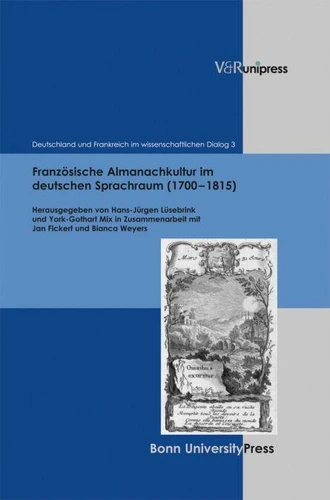
Französische Almanachkultur im deutschen Sprachraum (1700–1815). Gattungsstrukturen, komparatistische Aspekte, Diskursformen
Par : , , ,Formats :
Disponible dans votre compte client Decitre ou Furet du Nord dès validation de votre commande. Le format PDF est :
- Compatible avec une lecture sur My Vivlio (smartphone, tablette, ordinateur)
- Compatible avec une lecture sur liseuses Vivlio
- Pour les liseuses autres que Vivlio, vous devez utiliser le logiciel Adobe Digital Edition. Non compatible avec la lecture sur les liseuses Kindle, Remarkable et Sony
 , qui est-ce ?
Notre partenaire de plateforme de lecture numérique où vous retrouverez l'ensemble de vos ebooks gratuitement
Pour en savoir plus sur nos ebooks, consultez notre aide en ligne ici
C'est si simple ! Lisez votre ebook avec l'app Vivlio sur votre tablette, mobile ou ordinateur :

- Nombre de pages318
- FormatPDF
- ISBN978-3-86234-892-3
- EAN9783862348923
- Date de parution24/04/2013
- Protection num.pas de protection
- Taille3 Mo
- Infos supplémentairespdf
- ÉditeurV&R Unipress
Résumé
Dieser Band widmet sich dem umfassenden Korpus französischsprachiger Almanache, die bis zum Ende der Napoleonischen Ära im deutschen Sprach- und Kulturraum gedruckt, verlegt und rezipiert wurden. Er analysiert diese bisher unerschlossenen Quellen aus literatur-, kultur- und medienwissenschaftlicher Perspektive. In 13 Einzelstudien wird deutlich, dass es sich bei den auf ein Elitenpublikum zielenden frankophonen Almanachen um inhaltlich breit gefächerte und in genrespezifischer Hinsicht hoch differenzierte, transkulturell orientierte Periodika handelt.
Die Untersuchungen dieses frankophonen Alltagsmediums im deutschsprachigen Raum dokumentieren zudem die Mehrsprachigkeit der Aufklärung und offenbaren ein differenziertes Interesse für die Kultur der Nachbarnationen, wodurch die Realität der transkulturellen Verbindungen zwischen den europäischen Literaturen nachdrücklich ins Bewusstsein gehoben wird. This volume introduces the francophone almanacs published in the German linguistic and cultural world by through the end of the Napoleonic era.
It additionally analyzes this previously untapped and largely unknown corpus against the backdrop of literary, cultural and media studies. With regards to francophone almanacs targeting an elite audience, it is apparent that the content is wideranging, while the genre is highly differentiated and transculturally oriented. These periodicals may include literary soft-cover books, lady's almanacs, royal almanacs, theatre almanacs, muses' almanacs, antirevolutionary almanacs and state almanacs.
All of these qualify the general notion of one public, one audience, or the national literatures. Moreover, they impressively document multilingualism of the German Enlightenment in an European context. This also questions the paradigm shift to the English culture from 1770 onwards, established by historiography, and basically taps a field ignored by national philology.
Die Untersuchungen dieses frankophonen Alltagsmediums im deutschsprachigen Raum dokumentieren zudem die Mehrsprachigkeit der Aufklärung und offenbaren ein differenziertes Interesse für die Kultur der Nachbarnationen, wodurch die Realität der transkulturellen Verbindungen zwischen den europäischen Literaturen nachdrücklich ins Bewusstsein gehoben wird. This volume introduces the francophone almanacs published in the German linguistic and cultural world by through the end of the Napoleonic era.
It additionally analyzes this previously untapped and largely unknown corpus against the backdrop of literary, cultural and media studies. With regards to francophone almanacs targeting an elite audience, it is apparent that the content is wideranging, while the genre is highly differentiated and transculturally oriented. These periodicals may include literary soft-cover books, lady's almanacs, royal almanacs, theatre almanacs, muses' almanacs, antirevolutionary almanacs and state almanacs.
All of these qualify the general notion of one public, one audience, or the national literatures. Moreover, they impressively document multilingualism of the German Enlightenment in an European context. This also questions the paradigm shift to the English culture from 1770 onwards, established by historiography, and basically taps a field ignored by national philology.
A propos de Hans-Jürgen Lüsebrink
18,99 €