
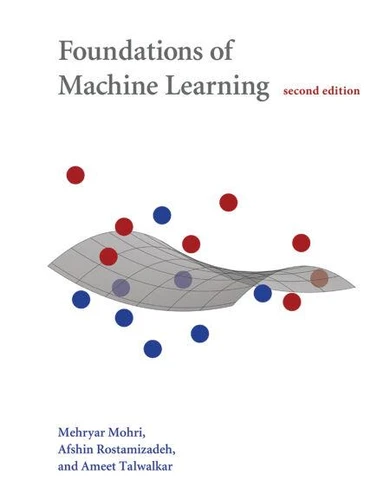
Foundations of Machine Learning
2nd edition
Par : , , Formats :
Disponible dans votre compte client Decitre ou Furet du Nord dès validation de votre commande. Le format ePub protégé est :
- Compatible avec une lecture sur My Vivlio (smartphone, tablette, ordinateur)
- Compatible avec une lecture sur liseuses Vivlio
- Pour les liseuses autres que Vivlio, vous devez utiliser le logiciel Adobe Digital Edition. Non compatible avec la lecture sur les liseuses Kindle, Remarkable et Sony
- Non compatible avec un achat hors France métropolitaine
 , qui est-ce ?
Notre partenaire de plateforme de lecture numérique où vous retrouverez l'ensemble de vos ebooks gratuitement
Pour en savoir plus sur nos ebooks, consultez notre aide en ligne ici
C'est si simple ! Lisez votre ebook avec l'app Vivlio sur votre tablette, mobile ou ordinateur :

- Nombre de pages504
- FormatePub
- ISBN978-0-262-35136-2
- EAN9780262351362
- Date de parution25/12/2018
- Protection num.Adobe DRM
- Taille25 Mo
- Infos supplémentairesepub
- ÉditeurThe MIT Press
Résumé
A new edition of a graduate-level machine learning textbook that focuses on the analysis and theory of algorithms. This book is a general introduction to machine learning that can serve as a textbook for graduate students and a reference for researchers. It covers fundamental modern topics in machine learning while providing the theoretical basis and conceptual tools needed for the discussion and justification of algorithms.
It also describes several key aspects of the application of these algorithms. The authors aim to present novel theoretical tools and concepts while giving concise proofs even for relatively advanced topics. Foundations of Machine Learning is unique in its focus on the analysis and theory of algorithms. The first four chapters lay the theoretical foundation for what follows; subsequent chapters are mostly self-contained.
Topics covered include the Probably Approximately Correct (PAC) learning framework; generalization bounds based on Rademacher complexity and VC-dimension; Support Vector Machines (SVMs); kernel methods; boosting; on-line learning; multi-class classification; ranking; regression; algorithmic stability; dimensionality reduction; learning automata and languages; and reinforcement learning. Each chapter ends with a set of exercises.
Appendixes provide additional material including concise probability review. This second edition offers three new chapters, on model selection, maximum entropy models, and conditional entropy models. New material in the appendixes includes a major section on Fenchel duality, expanded coverage of concentration inequalities, and an entirely new entry on information theory. More than half of the exercises are new to this edition.
It also describes several key aspects of the application of these algorithms. The authors aim to present novel theoretical tools and concepts while giving concise proofs even for relatively advanced topics. Foundations of Machine Learning is unique in its focus on the analysis and theory of algorithms. The first four chapters lay the theoretical foundation for what follows; subsequent chapters are mostly self-contained.
Topics covered include the Probably Approximately Correct (PAC) learning framework; generalization bounds based on Rademacher complexity and VC-dimension; Support Vector Machines (SVMs); kernel methods; boosting; on-line learning; multi-class classification; ranking; regression; algorithmic stability; dimensionality reduction; learning automata and languages; and reinforcement learning. Each chapter ends with a set of exercises.
Appendixes provide additional material including concise probability review. This second edition offers three new chapters, on model selection, maximum entropy models, and conditional entropy models. New material in the appendixes includes a major section on Fenchel duality, expanded coverage of concentration inequalities, and an entirely new entry on information theory. More than half of the exercises are new to this edition.