SOLDES
Jusqu'à -70% sur une sélection d'articles*

Nouveauté
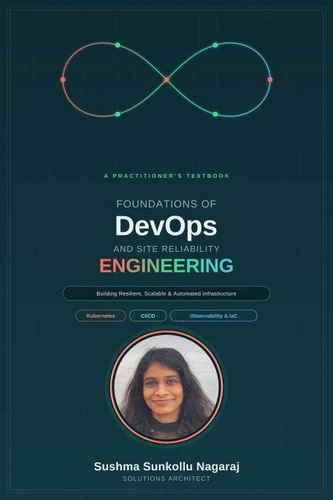
Foundations of DevOps and Site Reliability Engineering Building Resilient, Scalable, and Automated Infrastructure for the Modern Enterprise
Par :Formats :
Disponible dans votre compte client Decitre ou Furet du Nord dès validation de votre commande. Le format ePub est :
- Compatible avec une lecture sur My Vivlio (smartphone, tablette, ordinateur)
- Compatible avec une lecture sur liseuses Vivlio
- Pour les liseuses autres que Vivlio, vous devez utiliser le logiciel Adobe Digital Edition. Non compatible avec la lecture sur les liseuses Kindle, Remarkable et Sony
 , qui est-ce ?
Notre partenaire de plateforme de lecture numérique où vous retrouverez l'ensemble de vos ebooks gratuitement
Pour en savoir plus sur nos ebooks, consultez notre aide en ligne ici
C'est si simple ! Lisez votre ebook avec l'app Vivlio sur votre tablette, mobile ou ordinateur :

- FormatePub
- ISBN8235232914
- EAN9798235232914
- Date de parution29/06/2026
- Protection num.pas de protection
- Infos supplémentairesepub
- ÉditeurIoakim Ioakim
Résumé
Foundations of DevOps and Site Reliability Engineering - SummaryFoundations of DevOps and Site Reliability Engineering by Sushma Sunkollu Nagaraj is a comprehensive textbook that equips readers to design, implement, and operate modern infrastructure across two complementary disciplines. Subtitled Building Resilient, Scalable, and Automated Infrastructure for the Modern Enterprise, it balances theoretical foundations with practical guidance, progressing in each chapter from fundamental concepts to implementation detail so readers understand both why approaches are recommended and how to apply them.
It suits newcomers entering the field and practitioners deepening existing expertise. The book spans ten chapters. Chapter 1 traces the genesis of the DevOps movement-coined around 2008-2009 by Patrick Debois-and its core principles of collaboration, automation, continuous improvement, and systems thinking. It introduces the Three Ways (flow, feedback, and continual experimentation) and the key delivery metrics that distinguish high performers: deployment frequency, lead time for changes, change failure rate, and mean time to recovery.
Chapter 2 covers Site Reliability Engineering, the Google-originated discipline of applying software engineering to operations. It explains Service Level Indicators, Objectives, and error budgets; eliminating toil; managing reliability trade-offs (where each additional "nine" costs exponentially more); and SRE team structures from centralized to embedded models. Chapter 3 addresses Infrastructure as Code, treating infrastructure as version-controlled software.
It covers declarative principles, Terraform provisioning, Ansible configuration management, immutable infrastructure patterns that eliminate configuration drift, and GitOps with pull-based, reconciliation-driven operations. Chapter 4 presents Continuous Integration and Continuous Delivery-CI principles, building effective pipelines, delivery versus deployment, deployment strategies (blue-green, canary, rolling), and pipeline security.
Chapter 5 explores containerization and Docker, including image and Dockerfile best practices, container networking, storage, and security. Chapter 6 covers Kubernetes architecture, application deployment, networking and services, scaling and resource management, and cluster security. Chapter 7 examines monitoring and observability through the three pillars-metrics, logs, and traces-plus visualization, log aggregation, distributed tracing, and alerting and incident response.
Chapter 8 surveys cloud platforms: fundamentals, a comparison of major providers, managed Kubernetes services, serverless computing, and cloud cost management. Chapter 9 addresses security and compliance, covering DevSecOps principles, identity and access management, network security, compliance and governance, and incident response and recovery. Chapter 10 closes with future trends and career development-emerging technologies, skill-building, organizational transformation, building high-performing teams, and the future of both disciplines.
It suits newcomers entering the field and practitioners deepening existing expertise. The book spans ten chapters. Chapter 1 traces the genesis of the DevOps movement-coined around 2008-2009 by Patrick Debois-and its core principles of collaboration, automation, continuous improvement, and systems thinking. It introduces the Three Ways (flow, feedback, and continual experimentation) and the key delivery metrics that distinguish high performers: deployment frequency, lead time for changes, change failure rate, and mean time to recovery.
Chapter 2 covers Site Reliability Engineering, the Google-originated discipline of applying software engineering to operations. It explains Service Level Indicators, Objectives, and error budgets; eliminating toil; managing reliability trade-offs (where each additional "nine" costs exponentially more); and SRE team structures from centralized to embedded models. Chapter 3 addresses Infrastructure as Code, treating infrastructure as version-controlled software.
It covers declarative principles, Terraform provisioning, Ansible configuration management, immutable infrastructure patterns that eliminate configuration drift, and GitOps with pull-based, reconciliation-driven operations. Chapter 4 presents Continuous Integration and Continuous Delivery-CI principles, building effective pipelines, delivery versus deployment, deployment strategies (blue-green, canary, rolling), and pipeline security.
Chapter 5 explores containerization and Docker, including image and Dockerfile best practices, container networking, storage, and security. Chapter 6 covers Kubernetes architecture, application deployment, networking and services, scaling and resource management, and cluster security. Chapter 7 examines monitoring and observability through the three pillars-metrics, logs, and traces-plus visualization, log aggregation, distributed tracing, and alerting and incident response.
Chapter 8 surveys cloud platforms: fundamentals, a comparison of major providers, managed Kubernetes services, serverless computing, and cloud cost management. Chapter 9 addresses security and compliance, covering DevSecOps principles, identity and access management, network security, compliance and governance, and incident response and recovery. Chapter 10 closes with future trends and career development-emerging technologies, skill-building, organizational transformation, building high-performing teams, and the future of both disciplines.