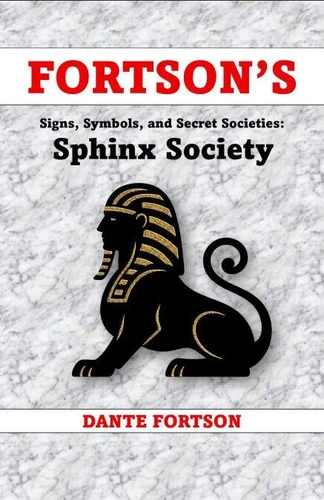
Fortson's Signs, Symbols, and Secret Societies: The Sphinx Society. Fortson's Signs, Symbols, and Secret Societies
Par :Formats :
Disponible dans votre compte client Decitre ou Furet du Nord dès validation de votre commande. Le format ePub est :
- Compatible avec une lecture sur My Vivlio (smartphone, tablette, ordinateur)
- Compatible avec une lecture sur liseuses Vivlio
- Pour les liseuses autres que Vivlio, vous devez utiliser le logiciel Adobe Digital Edition. Non compatible avec la lecture sur les liseuses Kindle, Remarkable et Sony
 , qui est-ce ?
Notre partenaire de plateforme de lecture numérique où vous retrouverez l'ensemble de vos ebooks gratuitement
Pour en savoir plus sur nos ebooks, consultez notre aide en ligne ici
C'est si simple ! Lisez votre ebook avec l'app Vivlio sur votre tablette, mobile ou ordinateur :

- FormatePub
- ISBN8233196232
- EAN9798233196232
- Date de parution13/02/2026
- Protection num.pas de protection
- Infos supplémentairesepub
- ÉditeurLinda Balsamo
Résumé
The history of secret societies is often a tapestry of myth, conjecture, and fragmented records, but few organizations carry the weight of mystery associated with the Sphinx Society. Founded on the principle that ancient architectural wonders were not merely monuments but repositories of pre-diluvian knowledge, the Society has operated in the shadows of academia and theology for centuries. To understand the Sphinx Society, one must first understand the symbol from which it takes its name.
The Great Sphinx of Giza, a limestone statue of a reclining sphinx, a mythical creature with the body of a lion and the head of a human, serves as the ultimate metaphor for the organization. It represents the silent guardian of secrets, a watcher that sees the passage of aeons while remaining immovable and inscrutable. The Society believes that the Sphinx is the key to a lost "Hall of Records, " a concept popularized in the 20th century but rooted in traditions that date back to the early Christian era and beyond.
The Society's origins are not found in Egypt, but in the intellectual ferment of the late Renaissance and early Enlightenment. During this period, European scholars began to look toward the East with a mixture of reverence and greed. They were searching for the prisca theologia, the "ancient theology" that they believed was a single, true theology that threads through all religions and was given by God to man in antiquity.
The Sphinx Society emerged as a radical offshoot of Rosicrucian and Hermetic circles, specifically focused on the physical remnants of the antediluvian world. While other groups focused on alchemy or political reform, the Sphinx Society was obsessed with the preservation of "Stone Wisdom." They argued that while books could burn and oral traditions could be corrupted, the proportions and placements of the Great Pyramids and the Sphinx were a mathematical language that could never be erased.
The Great Sphinx of Giza, a limestone statue of a reclining sphinx, a mythical creature with the body of a lion and the head of a human, serves as the ultimate metaphor for the organization. It represents the silent guardian of secrets, a watcher that sees the passage of aeons while remaining immovable and inscrutable. The Society believes that the Sphinx is the key to a lost "Hall of Records, " a concept popularized in the 20th century but rooted in traditions that date back to the early Christian era and beyond.
The Society's origins are not found in Egypt, but in the intellectual ferment of the late Renaissance and early Enlightenment. During this period, European scholars began to look toward the East with a mixture of reverence and greed. They were searching for the prisca theologia, the "ancient theology" that they believed was a single, true theology that threads through all religions and was given by God to man in antiquity.
The Sphinx Society emerged as a radical offshoot of Rosicrucian and Hermetic circles, specifically focused on the physical remnants of the antediluvian world. While other groups focused on alchemy or political reform, the Sphinx Society was obsessed with the preservation of "Stone Wisdom." They argued that while books could burn and oral traditions could be corrupted, the proportions and placements of the Great Pyramids and the Sphinx were a mathematical language that could never be erased.