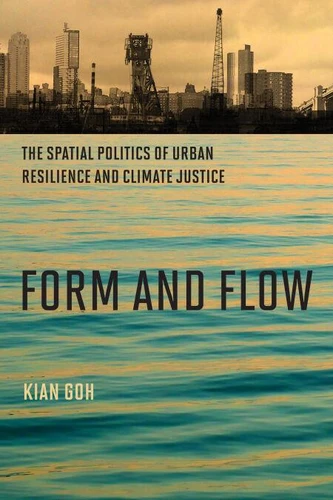
An examination of urban climate change response strategies and the resistance to them by grassroots activists and social movements. Cities around the world are formulating plans to respond to climate change and adapt to its impact. Often, marginalized urban residents resist these plans, offering "counterplans" to protest unjust and exclusionary actions. In this book, Kian Goh examines climate change response strategies in three cities-New York, Jakarta, and Rotterdam-and the mobilization of community groups to fight the perceived injustices and oversights of these plans.
Looking through the lenses of urban design and socioecological spatial politics, Goh reveals how contested visions of the future city are produced and gain power. Goh describes, on the one hand, a growing global network of urban environmental planning organizations intertwined with capitalist urban development, and, on the other, social movements that themselves often harness the power of networks.
She explores such initiatives as Rebuild By Design in New York, the Giant Sea Wall plan in Jakarta, and Rotterdam Climate Proof, and discovers competing narratives, including community resiliency in Brooklyn and grassroots activism in the informal "kampungs" of Jakarta. Drawing on participatory fieldwork and her own background in architecture and urban design, Goh offers both theoretical explanations and practical planning and design strategies.
She reframes the critical concerns of urban climate change responses, presenting a sociospatial typology of urban adaptation and considering the notion of a "just" resilience. Finally, she proposes a theoretical framework for designing equitable and just urban climate futures.
An examination of urban climate change response strategies and the resistance to them by grassroots activists and social movements. Cities around the world are formulating plans to respond to climate change and adapt to its impact. Often, marginalized urban residents resist these plans, offering "counterplans" to protest unjust and exclusionary actions. In this book, Kian Goh examines climate change response strategies in three cities-New York, Jakarta, and Rotterdam-and the mobilization of community groups to fight the perceived injustices and oversights of these plans.
Looking through the lenses of urban design and socioecological spatial politics, Goh reveals how contested visions of the future city are produced and gain power. Goh describes, on the one hand, a growing global network of urban environmental planning organizations intertwined with capitalist urban development, and, on the other, social movements that themselves often harness the power of networks.
She explores such initiatives as Rebuild By Design in New York, the Giant Sea Wall plan in Jakarta, and Rotterdam Climate Proof, and discovers competing narratives, including community resiliency in Brooklyn and grassroots activism in the informal "kampungs" of Jakarta. Drawing on participatory fieldwork and her own background in architecture and urban design, Goh offers both theoretical explanations and practical planning and design strategies.
She reframes the critical concerns of urban climate change responses, presenting a sociospatial typology of urban adaptation and considering the notion of a "just" resilience. Finally, she proposes a theoretical framework for designing equitable and just urban climate futures.

 , qui est-ce ?
