In Flaxius: Leaves from the Life of an Immortal, Charles Godfrey Leland imagines the memoir fragments of a deathless wanderer whose long experience becomes a vehicle for satire, reflection, and historical fantasy. The book moves through episodes rather than a tightly unified plot, using the conceit of immortality to juxtapose ages, manners, and beliefs. Its style is characteristically learned yet playful: conversational, ironic, and rich in anecdotal digression, with the lightness of a feuilleton and the speculative reach of nineteenth-century philosophical romance.
Within the literary context of fin-de-siècle imaginative prose, it stands near works that use the supernatural premise not for sensation alone but for social observation and intellectual experiment. Leland was an American-born man of letters, folklorist, journalist, and indefatigable collector of popular tradition. His wide travels in Europe, especially his deep engagement with Romany lore, Italian folk belief, and comparative mythology, sharpened his fascination with survivals across time-an interest well suited to the figure of an immortal observer.
The same mind that produced studies of magic, legend, and vernacular culture informs this book's cosmopolitan learning and amused skepticism. This is a rewarding volume for readers interested in Victorian fantasy, literary eccentricity, and the use of imagined biography as cultural critique. Flaxius deserves attention as a subtle, witty, and erudite meditation on time, memory, and civilization.
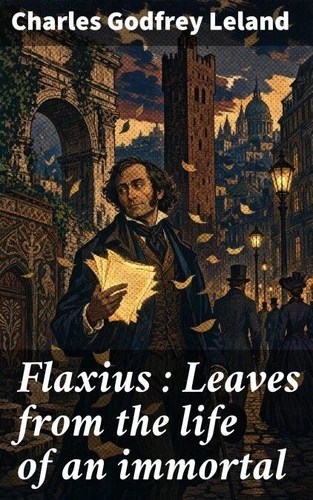
In Flaxius: Leaves from the Life of an Immortal, Charles Godfrey Leland imagines the memoir fragments of a deathless wanderer whose long experience becomes a vehicle for satire, reflection, and historical fantasy. The book moves through episodes rather than a tightly unified plot, using the conceit of immortality to juxtapose ages, manners, and beliefs. Its style is characteristically learned yet playful: conversational, ironic, and rich in anecdotal digression, with the lightness of a feuilleton and the speculative reach of nineteenth-century philosophical romance.
Within the literary context of fin-de-siècle imaginative prose, it stands near works that use the supernatural premise not for sensation alone but for social observation and intellectual experiment. Leland was an American-born man of letters, folklorist, journalist, and indefatigable collector of popular tradition. His wide travels in Europe, especially his deep engagement with Romany lore, Italian folk belief, and comparative mythology, sharpened his fascination with survivals across time-an interest well suited to the figure of an immortal observer.
The same mind that produced studies of magic, legend, and vernacular culture informs this book's cosmopolitan learning and amused skepticism. This is a rewarding volume for readers interested in Victorian fantasy, literary eccentricity, and the use of imagined biography as cultural critique. Flaxius deserves attention as a subtle, witty, and erudite meditation on time, memory, and civilization.


 , qui est-ce ?