
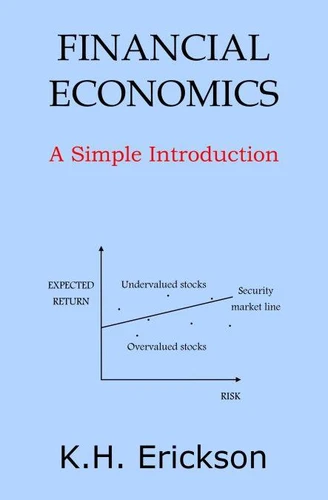
Financial Economics: A Simple Introduction. Simple Introductions, #3
Par :Formats :
Disponible dans votre compte client Decitre ou Furet du Nord dès validation de votre commande. Le format ePub est :
- Compatible avec une lecture sur My Vivlio (smartphone, tablette, ordinateur)
- Compatible avec une lecture sur liseuses Vivlio
- Pour les liseuses autres que Vivlio, vous devez utiliser le logiciel Adobe Digital Edition. Non compatible avec la lecture sur les liseuses Kindle, Remarkable et Sony
 , qui est-ce ?
Notre partenaire de plateforme de lecture numérique où vous retrouverez l'ensemble de vos ebooks gratuitement
Pour en savoir plus sur nos ebooks, consultez notre aide en ligne ici
C'est si simple ! Lisez votre ebook avec l'app Vivlio sur votre tablette, mobile ou ordinateur :

- FormatePub
- ISBN978-1-311-57199-1
- EAN9781311571991
- Date de parution25/10/2013
- Protection num.pas de protection
- Infos supplémentairesepub
- ÉditeurJPCA
Résumé
Financial Economics: A Simple Introduction offers an accessible guide to the central ideas and methods of financial economics, with examples and calculations, empirical evidence, and over 20 diagrams to support the analysis. Understand consumption and investment decisions, intertemporal choice, indifference curves and the marginal rate of substitution, production possibilities and the marginal rate of transformation, rates of return, the financial market line, borrowing and lending, and the Fisher Separation Theorem.
Portfolio theory examines expected returns, standard deviation and variance risk, covariance, correlation, asset diversification, market portfolio, a risk-free asset, the capital market line, and the Tobin Separation Theorem. The capital asset pricing model (CAPM) explores diversifiable and non-diversifiable risk, the beta risk factor, calculation of an asset's expected return, the security market line, asset evaluation, and empirical evidence on the CAPM.
Market efficiency looks at the efficient market hypothesis (EMH), weak, semi-strong, and strong form efficiency, and the literature on technical and fundamental analysis strategies to beat the market.
Portfolio theory examines expected returns, standard deviation and variance risk, covariance, correlation, asset diversification, market portfolio, a risk-free asset, the capital market line, and the Tobin Separation Theorem. The capital asset pricing model (CAPM) explores diversifiable and non-diversifiable risk, the beta risk factor, calculation of an asset's expected return, the security market line, asset evaluation, and empirical evidence on the CAPM.
Market efficiency looks at the efficient market hypothesis (EMH), weak, semi-strong, and strong form efficiency, and the literature on technical and fundamental analysis strategies to beat the market.


