
Bruno Johannsson studied economics, philosophy and theology and obtained a degree in economics. He has been active in research and teaching and has published on economic, philosophical and theological topics (see appendix). Thea Johannsson was a teacher in HIstory and German language and literature and publishes together with Bruno five volumes of philosophical dialogues about topics out of the fields of social philosophy, epistemology, ethics, anthropology and metaphysics.
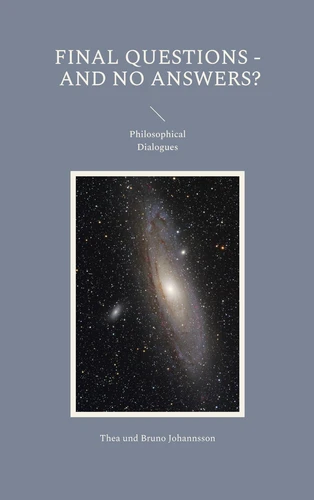
Final Questions - And No Answers?. Philosophical Dialogues
Par :Formats :
Disponible dans votre compte client Decitre ou Furet du Nord dès validation de votre commande. Le format ePub est :
- Compatible avec une lecture sur My Vivlio (smartphone, tablette, ordinateur)
- Compatible avec une lecture sur liseuses Vivlio
- Pour les liseuses autres que Vivlio, vous devez utiliser le logiciel Adobe Digital Edition. Non compatible avec la lecture sur les liseuses Kindle, Remarkable et Sony
 , qui est-ce ?
Notre partenaire de plateforme de lecture numérique où vous retrouverez l'ensemble de vos ebooks gratuitement
Pour en savoir plus sur nos ebooks, consultez notre aide en ligne ici
C'est si simple ! Lisez votre ebook avec l'app Vivlio sur votre tablette, mobile ou ordinateur :

- Nombre de pages240
- FormatePub
- ISBN978-3-7578-9743-7
- EAN9783757897437
- Date de parution13/04/2023
- Protection num.Digital Watermarking
- Taille247 Ko
- Infos supplémentairesepub
- ÉditeurBooks on Demand
Résumé
"Final questions" is a term used by the Australian philosopher Karl R. Popper, which indicates a field of philosophy in which Popper would esteem scientific proof impossible. The field is also called metaphysics. In this book Thea and Bruno discuss the problems of God's existence, eternal love and spirit, life after death, good and evil, evolution and creation. They do it in their modified Socratic midwifery method.
The reader can follow the birth of thought as it emerges in a mixture of logical discipline and spontaneous reaction. He can pause and pursue his own promptings. He is not confrontes with ready-made results, but involved in a discourse that ist open-endet and comprehensible.
The reader can follow the birth of thought as it emerges in a mixture of logical discipline and spontaneous reaction. He can pause and pursue his own promptings. He is not confrontes with ready-made results, but involved in a discourse that ist open-endet and comprehensible.
A propos de Thea und Bruno Johannsson
8,99 €