
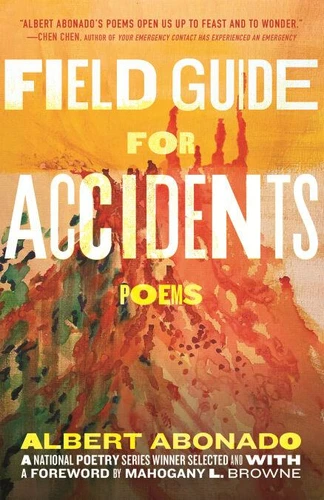
Field Guide for Accidents. Poems
Par : ,Formats :
Disponible dans votre compte client Decitre ou Furet du Nord dès validation de votre commande. Le format ePub protégé est :
- Compatible avec une lecture sur My Vivlio (smartphone, tablette, ordinateur)
- Compatible avec une lecture sur liseuses Vivlio
- Pour les liseuses autres que Vivlio, vous devez utiliser le logiciel Adobe Digital Edition. Non compatible avec la lecture sur les liseuses Kindle, Remarkable et Sony
- Non compatible avec un achat hors France métropolitaine
 , qui est-ce ?
Notre partenaire de plateforme de lecture numérique où vous retrouverez l'ensemble de vos ebooks gratuitement
Pour en savoir plus sur nos ebooks, consultez notre aide en ligne ici
C'est si simple ! Lisez votre ebook avec l'app Vivlio sur votre tablette, mobile ou ordinateur :

- Nombre de pages104
- FormatePub
- ISBN978-0-8070-2052-4
- EAN9780807020524
- Date de parution22/10/2024
- Protection num.Adobe DRM
- Taille1 Mo
- Infos supplémentairesepub
- ÉditeurBeacon Press
Résumé
SELECTED BY MAHOGANY L. BROWNE FOR THE NATIONAL POETRY SERIESAn irreverent poetry collection that wrestles with questions of family, mortality, cultural history, and identity from the Filipinx-American experience "you showed him your teeth, you dared him to look into your mouth to see the metal bands straightening your jaw into an American smile."-from Field Guide for AccidentsBorn in the United States to Filipino immigrants, poet Albert Abonado is no stranger to the language of periphery.
Neither wholly "American" nor Filipino, Field Guide for Accidents's speakers are defined by what they are not: not white enough to be born in America, not Asian enough to feel at home in the Philippines. Abonado's poetry illuminates the strange and surreal in domestic routine, suturing wounds of love, grief, and the contradiction of being Filipinx-American, two identities bound with a hyphen that resists negation.
What results is a growing exposure to a world mired in paradox. The poems in Field Guide for Accidents experiment with the constraints of the poetic line, shaping forms that exhume what tend to haunt us in the silence. In Field Guide for Accidents, memory becomes augmented with the imaginary; suspicion collides with superstition, while spirituality crosses paths with scientific fact. A mother returns to her son as a boat.
A stew is prepared with blood yet masked as chocolate. The living eat with the dead in memories built like houses. Mythic, bloodthirsty creatures in Pinoy folklore prey on an exhausted poet. Research conducted in hindsight provides new avenues to explore regret. For many third-culture kids of the Asian-American diaspora, there is no such thing as a success story for "fitting in." What matters more is finding where you belong.
Spooning images from hand to mouth, the poems in Field Guide for Accidents struggle with what it means to consume and be consumed by American culture.
Neither wholly "American" nor Filipino, Field Guide for Accidents's speakers are defined by what they are not: not white enough to be born in America, not Asian enough to feel at home in the Philippines. Abonado's poetry illuminates the strange and surreal in domestic routine, suturing wounds of love, grief, and the contradiction of being Filipinx-American, two identities bound with a hyphen that resists negation.
What results is a growing exposure to a world mired in paradox. The poems in Field Guide for Accidents experiment with the constraints of the poetic line, shaping forms that exhume what tend to haunt us in the silence. In Field Guide for Accidents, memory becomes augmented with the imaginary; suspicion collides with superstition, while spirituality crosses paths with scientific fact. A mother returns to her son as a boat.
A stew is prepared with blood yet masked as chocolate. The living eat with the dead in memories built like houses. Mythic, bloodthirsty creatures in Pinoy folklore prey on an exhausted poet. Research conducted in hindsight provides new avenues to explore regret. For many third-culture kids of the Asian-American diaspora, there is no such thing as a success story for "fitting in." What matters more is finding where you belong.
Spooning images from hand to mouth, the poems in Field Guide for Accidents struggle with what it means to consume and be consumed by American culture.