
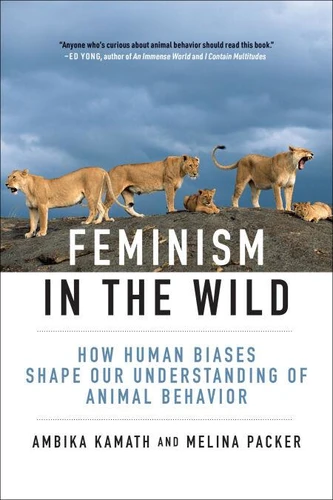
Feminism in the Wild. How Human Biases Shape Our Understanding of Animal Behavior
Par : ,Formats :
Disponible dans votre compte client Decitre ou Furet du Nord dès validation de votre commande. Le format ePub protégé est :
- Compatible avec une lecture sur My Vivlio (smartphone, tablette, ordinateur)
- Compatible avec une lecture sur liseuses Vivlio
- Pour les liseuses autres que Vivlio, vous devez utiliser le logiciel Adobe Digital Edition. Non compatible avec la lecture sur les liseuses Kindle, Remarkable et Sony
- Non compatible avec un achat hors France métropolitaine
 , qui est-ce ?
Notre partenaire de plateforme de lecture numérique où vous retrouverez l'ensemble de vos ebooks gratuitement
Pour en savoir plus sur nos ebooks, consultez notre aide en ligne ici
C'est si simple ! Lisez votre ebook avec l'app Vivlio sur votre tablette, mobile ou ordinateur :

- Nombre de pages208
- FormatePub
- ISBN978-0-262-38228-1
- EAN9780262382281
- Date de parution02/09/2025
- Protection num.Adobe DRM
- Taille1 Mo
- Infos supplémentairesepub
- ÉditeurThe MIT Press
Résumé
How dominant culture-from sexism and homophobia to racism, capitalism, ableism, and more-has limited the science of animal behavior, and how we can free ourselves from these limited perspectives. In Feminism in the Wild, Ambika Kamath and Melina Packer reveal how scientists studying animal behavior have long projected human norms and values onto animals while seeking to understand them. When scientific studies conclude that these norms and values are natural in animals, it makes it easier to think of them as natural in humans too.
And because scientists, historically and to this day, largely belong to elite, powerful segments of society, the norms and values embedded in animal behavior science match those of the already powerful. How can animal behavior science escape this trap of naturalizing dominant culture?Drawing from decades of feminist, antiracist, queer, disability justice, and Marxist contributions-including those of biologists-Kamath and Packer break down persistent assumptions in the status quo of animal behavior science and offer a multitude of alternative approaches.
Core concepts in animal behavior science and evolutionary biology-from sex categories and sexual selection to fitness, adaptation, biological determinism, and more-are carefully contextualized and critically reexamined. This unique collaboration between an animal behavior scientist and a feminist science studies scholar is an illuminating and hopeful read for anyone who is curious about how animals behave, and anyone who wants to break free from scientific approaches that perpetuate systems of oppression.
And because scientists, historically and to this day, largely belong to elite, powerful segments of society, the norms and values embedded in animal behavior science match those of the already powerful. How can animal behavior science escape this trap of naturalizing dominant culture?Drawing from decades of feminist, antiracist, queer, disability justice, and Marxist contributions-including those of biologists-Kamath and Packer break down persistent assumptions in the status quo of animal behavior science and offer a multitude of alternative approaches.
Core concepts in animal behavior science and evolutionary biology-from sex categories and sexual selection to fitness, adaptation, biological determinism, and more-are carefully contextualized and critically reexamined. This unique collaboration between an animal behavior scientist and a feminist science studies scholar is an illuminating and hopeful read for anyone who is curious about how animals behave, and anyone who wants to break free from scientific approaches that perpetuate systems of oppression.