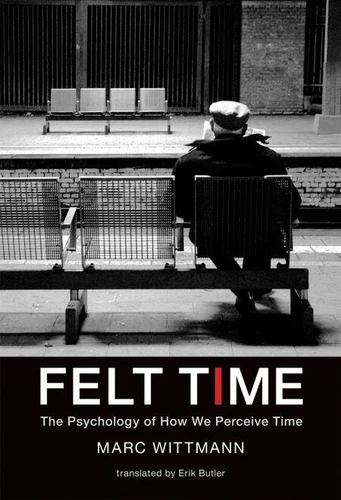
Felt Time. The Psychology of How We Perceive Time
Par : ,Formats :
Disponible dans votre compte client Decitre ou Furet du Nord dès validation de votre commande. Le format ePub protégé est :
- Compatible avec une lecture sur My Vivlio (smartphone, tablette, ordinateur)
- Compatible avec une lecture sur liseuses Vivlio
- Pour les liseuses autres que Vivlio, vous devez utiliser le logiciel Adobe Digital Edition. Non compatible avec la lecture sur les liseuses Kindle, Remarkable et Sony
- Non compatible avec un achat hors France métropolitaine
 , qui est-ce ?
Notre partenaire de plateforme de lecture numérique où vous retrouverez l'ensemble de vos ebooks gratuitement
Pour en savoir plus sur nos ebooks, consultez notre aide en ligne ici
C'est si simple ! Lisez votre ebook avec l'app Vivlio sur votre tablette, mobile ou ordinateur :

- Nombre de pages184
- FormatePub
- ISBN978-0-262-33387-0
- EAN9780262333870
- Date de parution10/02/2016
- Protection num.Adobe DRM
- Taille3 Mo
- Infos supplémentairesepub
- ÉditeurThe MIT Press
Résumé
An expert explores the riddle of subjective time, from why time speeds up as we grow older to the connection between time and consciousness. We have widely varying perceptions of time. Children have trouble waiting for anything. ("Are we there yet?") Boredom is often connected to our sense of time passing (or not passing). As people grow older, time seems to speed up, the years flitting by without a pause.
How does our sense of time come about? In Felt Time, Marc Wittmann explores the riddle of subjective time, explaining our perception of time-whether moment by moment, or in terms of life as a whole. Drawing on the latest insights from psychology and neuroscience, Wittmann offers a new answer to the question of how we experience time. Wittmann explains, among other things, how we choose between savoring the moment and deferring gratification; why impulsive people are bored easily, and why their boredom is often a matter of time; whether each person possesses a personal speed, a particular brain rhythm distinguishing quick people from slow people; and why the feeling of duration can serve as an "error signal, " letting us know when it is taking too long for dinner to be ready or for the bus to come.
He considers the practice of mindfulness, and whether it can reduce the speed of life and help us gain more time, and he describes how, as we grow older, subjective time accelerates as routine increases; a fulfilled and varied life is a long life. Evidence shows that bodily processes-especially the heartbeat-underlie our feeling of time and act as an internal clock for our sense of time. And Wittmann points to recent research that connects time to consciousness; ongoing studies of time consciousness, he tells us, will help us to understand the conscious self.
How does our sense of time come about? In Felt Time, Marc Wittmann explores the riddle of subjective time, explaining our perception of time-whether moment by moment, or in terms of life as a whole. Drawing on the latest insights from psychology and neuroscience, Wittmann offers a new answer to the question of how we experience time. Wittmann explains, among other things, how we choose between savoring the moment and deferring gratification; why impulsive people are bored easily, and why their boredom is often a matter of time; whether each person possesses a personal speed, a particular brain rhythm distinguishing quick people from slow people; and why the feeling of duration can serve as an "error signal, " letting us know when it is taking too long for dinner to be ready or for the bus to come.
He considers the practice of mindfulness, and whether it can reduce the speed of life and help us gain more time, and he describes how, as we grow older, subjective time accelerates as routine increases; a fulfilled and varied life is a long life. Evidence shows that bodily processes-especially the heartbeat-underlie our feeling of time and act as an internal clock for our sense of time. And Wittmann points to recent research that connects time to consciousness; ongoing studies of time consciousness, he tells us, will help us to understand the conscious self.