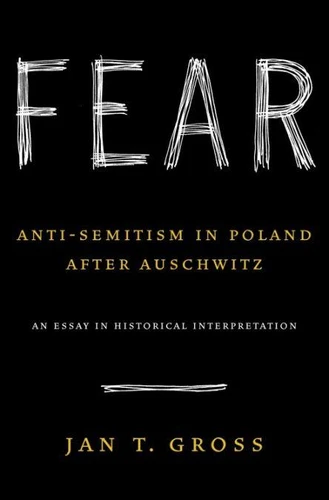
Fear. Anti-Semitism in Poland After Auschwitz
Par :Formats :
Disponible dans votre compte client Decitre ou Furet du Nord dès validation de votre commande. Le format ePub protégé est :
- Compatible avec une lecture sur My Vivlio (smartphone, tablette, ordinateur)
- Compatible avec une lecture sur liseuses Vivlio
- Pour les liseuses autres que Vivlio, vous devez utiliser le logiciel Adobe Digital Edition. Non compatible avec la lecture sur les liseuses Kindle, Remarkable et Sony
- Non compatible avec un achat hors France métropolitaine
 , qui est-ce ?
Notre partenaire de plateforme de lecture numérique où vous retrouverez l'ensemble de vos ebooks gratuitement
Pour en savoir plus sur nos ebooks, consultez notre aide en ligne ici
C'est si simple ! Lisez votre ebook avec l'app Vivlio sur votre tablette, mobile ou ordinateur :

- Nombre de pages320
- FormatePub
- ISBN978-0-307-43096-0
- EAN9780307430960
- Date de parution18/12/2007
- Protection num.Adobe DRM
- Taille3 Mo
- Infos supplémentairesepub
- ÉditeurRandom House
Résumé
An astonishing and heartbreaking study of the Polish Holocaust survivors who returned home only to face continued violence and anti-Semitism at the hands of their neighbors "[Fear] culminates in so keen a shock that even a student of the Jewish tragedy during World War II cannot fail to feel it."-Elie Wiesel FINALIST FOR THE NATIONAL JEWISH BOOK AWARD . NAMED ONE OF THE BEST BOOKS OF THE YEAR BY THE WASHINGTON POST BOOK WORLD Poland suffered an exceedingly brutal Nazi occupation during the Second World War, in which 90 percent of the country's three and a half million Jews perished.
Yet despite this unprecedented calamity, Jewish Holocaust survivors returning to their hometowns in Poland after the war were further subjected to terror and bloodshed. The deadliest peacetime pogrom in twentieth-century Europe took place in the Polish town of Kielce on July 4, 1946. In Fear, Jan T. Gross addresses a vexing question: How was this possible? At the center of his investigation is a detailed reconstruction of the Kielce pogrom and how ordinary Poles responded to the spectacle of Jews being murdered by their fellow citizens.
Anti-Semitism, Gross argues, became a common currency between the Communist regime and a society in which many were complicit in the Nazi campaign of plunder and murder-and for whom the Jewish survivors were a standing reproach. For more than half a century, the fate of Jewish Holocaust survivors in Poland was cloaked in guilt and shame. Writing with passion, brilliance, and fierce clarity, Jan T.
Gross brings to light a truth that must never be ignored. Praise for Fear "That a civilized nation could have descended so low .
Yet despite this unprecedented calamity, Jewish Holocaust survivors returning to their hometowns in Poland after the war were further subjected to terror and bloodshed. The deadliest peacetime pogrom in twentieth-century Europe took place in the Polish town of Kielce on July 4, 1946. In Fear, Jan T. Gross addresses a vexing question: How was this possible? At the center of his investigation is a detailed reconstruction of the Kielce pogrom and how ordinary Poles responded to the spectacle of Jews being murdered by their fellow citizens.
Anti-Semitism, Gross argues, became a common currency between the Communist regime and a society in which many were complicit in the Nazi campaign of plunder and murder-and for whom the Jewish survivors were a standing reproach. For more than half a century, the fate of Jewish Holocaust survivors in Poland was cloaked in guilt and shame. Writing with passion, brilliance, and fierce clarity, Jan T.
Gross brings to light a truth that must never be ignored. Praise for Fear "That a civilized nation could have descended so low .