SOLDES
Jusqu'à -70% sur une sélection d'articles*

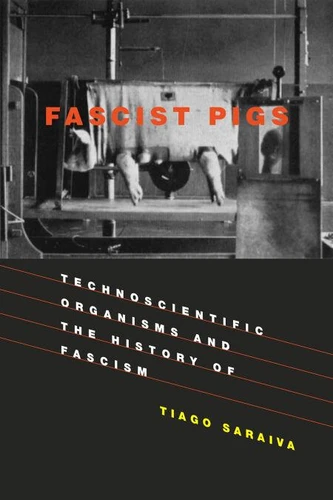
Fascist Pigs. Technoscientific Organisms and the History of Fascism
Par :Formats :
Disponible dans votre compte client Decitre ou Furet du Nord dès validation de votre commande. Le format ePub protégé est :
- Compatible avec une lecture sur My Vivlio (smartphone, tablette, ordinateur)
- Compatible avec une lecture sur liseuses Vivlio
- Pour les liseuses autres que Vivlio, vous devez utiliser le logiciel Adobe Digital Edition. Non compatible avec la lecture sur les liseuses Kindle, Remarkable et Sony
- Non compatible avec un achat hors France métropolitaine
 , qui est-ce ?
Notre partenaire de plateforme de lecture numérique où vous retrouverez l'ensemble de vos ebooks gratuitement
Pour en savoir plus sur nos ebooks, consultez notre aide en ligne ici
C'est si simple ! Lisez votre ebook avec l'app Vivlio sur votre tablette, mobile ou ordinateur :

- Nombre de pages344
- FormatePub
- ISBN978-0-262-33571-3
- EAN9780262335713
- Date de parution07/10/2016
- Protection num.Adobe DRM
- Taille9 Mo
- Infos supplémentairesepub
- ÉditeurThe MIT Press
Résumé
How the breeding of new animals and plants was central to fascist regimes in Italy, Portugal, and Germany and to their imperial expansion. In the fascist regimes of Mussolini's Italy, Salazar's Portugal, and Hitler's Germany, the first mass mobilizations involved wheat engineered to take advantage of chemical fertilizers, potatoes resistant to late blight, and pigs that thrived on national produce.
Food independence was an early goal of fascism; indeed, as Tiago Saraiva writes in Fascist Pigs, fascists were obsessed with projects to feed the national body from the national soil. Saraiva shows how such technoscientific organisms as specially bred wheat and pigs became important elements in the institutionalization and expansion of fascist regimes. The pigs, the potatoes, and the wheat embodied fascism.
In Nazi Germany, only plants and animals conforming to the new national standards would be allowed to reproduce. Pigs that didn't efficiently convert German-grown potatoes into pork and lard were eliminated. Saraiva describes national campaigns that intertwined the work of geneticists with new state bureaucracies; discusses fascist empires, considering forced labor on coffee, rubber, and cotton in Ethiopia, Mozambique, and Eastern Europe; and explores fascist genocides, following Karakul sheep from a laboratory in Germany to Eastern Europe, Libya, Ethiopia, and Angola.
Saraiva's highly original account-the first systematic study of the relation between science and fascism-argues that the "back to the land" aspect of fascism should be understood as a modernist experiment involving geneticists and their organisms, mass propaganda, overgrown bureaucracy, and violent colonialism.
Food independence was an early goal of fascism; indeed, as Tiago Saraiva writes in Fascist Pigs, fascists were obsessed with projects to feed the national body from the national soil. Saraiva shows how such technoscientific organisms as specially bred wheat and pigs became important elements in the institutionalization and expansion of fascist regimes. The pigs, the potatoes, and the wheat embodied fascism.
In Nazi Germany, only plants and animals conforming to the new national standards would be allowed to reproduce. Pigs that didn't efficiently convert German-grown potatoes into pork and lard were eliminated. Saraiva describes national campaigns that intertwined the work of geneticists with new state bureaucracies; discusses fascist empires, considering forced labor on coffee, rubber, and cotton in Ethiopia, Mozambique, and Eastern Europe; and explores fascist genocides, following Karakul sheep from a laboratory in Germany to Eastern Europe, Libya, Ethiopia, and Angola.
Saraiva's highly original account-the first systematic study of the relation between science and fascism-argues that the "back to the land" aspect of fascism should be understood as a modernist experiment involving geneticists and their organisms, mass propaganda, overgrown bureaucracy, and violent colonialism.