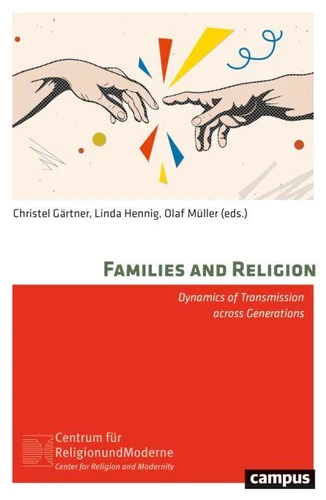
Families and Religion. Dynamics of Transmission across Generations
Par : , , , ,Formats :
Disponible dans votre compte client Decitre ou Furet du Nord dès validation de votre commande. Le format ePub est :
- Compatible avec une lecture sur My Vivlio (smartphone, tablette, ordinateur)
- Compatible avec une lecture sur liseuses Vivlio
- Pour les liseuses autres que Vivlio, vous devez utiliser le logiciel Adobe Digital Edition. Non compatible avec la lecture sur les liseuses Kindle, Remarkable et Sony
 , qui est-ce ?
Notre partenaire de plateforme de lecture numérique où vous retrouverez l'ensemble de vos ebooks gratuitement
Pour en savoir plus sur nos ebooks, consultez notre aide en ligne ici
C'est si simple ! Lisez votre ebook avec l'app Vivlio sur votre tablette, mobile ou ordinateur :

- Nombre de pages425
- FormatePub
- ISBN978-3-593-45972-1
- EAN9783593459721
- Date de parution20/03/2025
- Protection num.Digital Watermarking
- Taille6 Mo
- Infos supplémentairesepub
- ÉditeurCampus
Résumé
This comparative study examines the transmission of religion in families in Germany, Italy, Hungary, Finland and Canada. The authors rely on the widely shared argument that religious change can primarily be understood as an intergenerational process. Based on a mixed-methods design, the book investigates the question of how, when exactly and under what conditions the following generations become less religious than the previous ones.
From the perspective of familial and historical generations, the authors examine the significance of (religious) socialization for the transmission of (non-)religious worldviews, affiliation, practice, and identity. According to a central finding, religious change takes place primarily in the phase of adolescence against the background of the respective social context.
From the perspective of familial and historical generations, the authors examine the significance of (religious) socialization for the transmission of (non-)religious worldviews, affiliation, practice, and identity. According to a central finding, religious change takes place primarily in the phase of adolescence against the background of the respective social context.