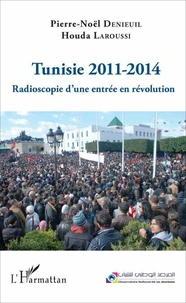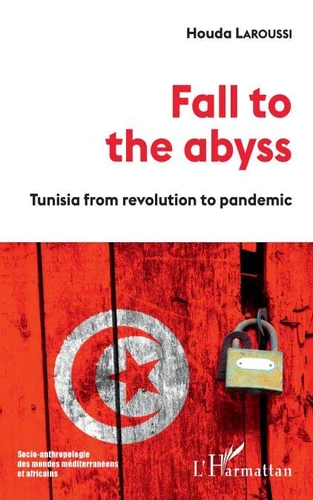
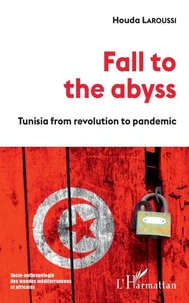
Fall to the abyss. Tunisia from revolution to pandemic
Par :Formats :
Disponible dans votre compte client Decitre ou Furet du Nord dès validation de votre commande. Le format ePub est :
- Compatible avec une lecture sur My Vivlio (smartphone, tablette, ordinateur)
- Compatible avec une lecture sur liseuses Vivlio
- Pour les liseuses autres que Vivlio, vous devez utiliser le logiciel Adobe Digital Edition. Non compatible avec la lecture sur les liseuses Kindle, Remarkable et Sony
 , qui est-ce ?
Notre partenaire de plateforme de lecture numérique où vous retrouverez l'ensemble de vos ebooks gratuitement
Pour en savoir plus sur nos ebooks, consultez notre aide en ligne ici
C'est si simple ! Lisez votre ebook avec l'app Vivlio sur votre tablette, mobile ou ordinateur :

- Nombre de pages120
- FormatePub
- ISBN978-2-336-92871-5
- EAN9782336928715
- Date de parution29/04/2021
- Protection num.Digital Watermarking
- Taille2 Mo
- Infos supplémentairesepub
- ÉditeurL'Harmattan
Résumé
This essay shows that the covid 19 has become a social phenomenon that deeply imprints individual and collective behaviours, both in social distancing and in solid laarity. He interprets the pandemic as a radical change, an unprecedented shift in the course of societies. This Coronavirage is an opportunity for the author to examine, from Tunisia, another order of the world. Tunisian society is apprehended in a new geopolitical framework : its links with the United States and its allies in the Near East, in a context of American-Chinese rivalries and the weakening of Europe.
Tunisia is revealed in its internal logic of response to the pandemic, notably by the persistence of political and financial corruption, as well as by the resurgence of the parallel market and informal practices. In this perspective, the author in respondent to a new project of social and solidarity economy, which would take place in the construction of a third sector, in complementarity with the respondent to the private sector, to replace the current informal and clandestine practices.
Tunisia is revealed in its internal logic of response to the pandemic, notably by the persistence of political and financial corruption, as well as by the resurgence of the parallel market and informal practices. In this perspective, the author in respondent to a new project of social and solidarity economy, which would take place in the construction of a third sector, in complementarity with the respondent to the private sector, to replace the current informal and clandestine practices.
A propos de Houda Laroussi


24,99 €