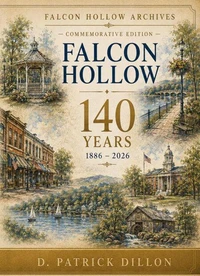
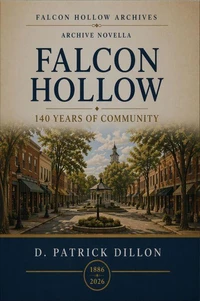
Falcon Hollow: A Historical Perspective examines how a town is shaped not only by events, but by the structures, landscapes, and recurring roles that sustain daily life. Rather than presenting a conventional chronological history, this work assembles the elements that quietly organize Falcon Hollow and places them in relation to one another. Beginning with the terrain itself-the basin, the ridges, and the lake that gathers the town-this study explores how geography influences settlement patterns, movement, and perception.
From there it turns to the structures that endure beyond their original purposes: the mill at the edge of town, the evolving storefronts along Main Street, and the civic circle where governance, memory, and public life converge. The final section examines the human positions that persist within these spaces. Certain roles reappear across generations: the observer who notices patterns, the keeper of informal knowledge behind a counter, the places where residents gather and information settles before it travels farther.
These roles are rarely formalized, yet they shape how a community understands itself. Throughout the book, Falcon Hollow is treated less as a collection of dramatic events and more as a system of relationships-between land and settlement, between buildings and memory, between daily routines and the structures that quietly support them. The result is not a definitive explanation of the town, but a configuration that reveals how continuity forms through repetition, adaptation, and restraint.
By assembling familiar places and roles into a single frame, Falcon Hollow: A Historical Perspective offers a way of seeing how communities endure-not through spectacle or legend, but through alignment between landscape, structure, and the people who occupy them.
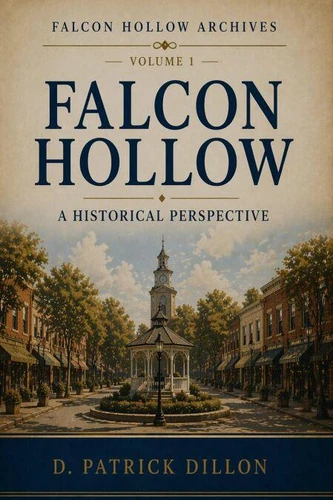
Falcon Hollow: A Historical Perspective examines how a town is shaped not only by events, but by the structures, landscapes, and recurring roles that sustain daily life. Rather than presenting a conventional chronological history, this work assembles the elements that quietly organize Falcon Hollow and places them in relation to one another. Beginning with the terrain itself-the basin, the ridges, and the lake that gathers the town-this study explores how geography influences settlement patterns, movement, and perception.
From there it turns to the structures that endure beyond their original purposes: the mill at the edge of town, the evolving storefronts along Main Street, and the civic circle where governance, memory, and public life converge. The final section examines the human positions that persist within these spaces. Certain roles reappear across generations: the observer who notices patterns, the keeper of informal knowledge behind a counter, the places where residents gather and information settles before it travels farther.
These roles are rarely formalized, yet they shape how a community understands itself. Throughout the book, Falcon Hollow is treated less as a collection of dramatic events and more as a system of relationships-between land and settlement, between buildings and memory, between daily routines and the structures that quietly support them. The result is not a definitive explanation of the town, but a configuration that reveals how continuity forms through repetition, adaptation, and restraint.
By assembling familiar places and roles into a single frame, Falcon Hollow: A Historical Perspective offers a way of seeing how communities endure-not through spectacle or legend, but through alignment between landscape, structure, and the people who occupy them.


 , qui est-ce ?