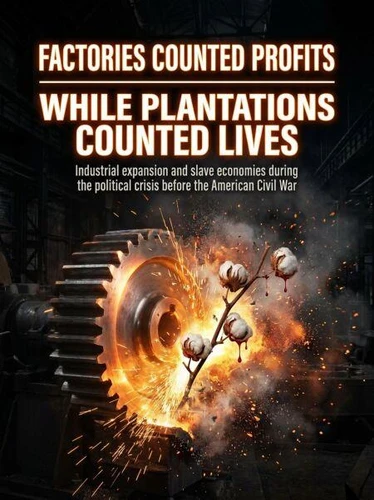
Factories Counted Profits While Plantations Counted Lives. Industrial expansion and slave economies during the political crisis before the American Civil War
Par :Formats :
Disponible dans votre compte client Decitre ou Furet du Nord dès validation de votre commande. Le format ePub est :
- Compatible avec une lecture sur My Vivlio (smartphone, tablette, ordinateur)
- Compatible avec une lecture sur liseuses Vivlio
- Pour les liseuses autres que Vivlio, vous devez utiliser le logiciel Adobe Digital Edition. Non compatible avec la lecture sur les liseuses Kindle, Remarkable et Sony
 , qui est-ce ?
Notre partenaire de plateforme de lecture numérique où vous retrouverez l'ensemble de vos ebooks gratuitement
Pour en savoir plus sur nos ebooks, consultez notre aide en ligne ici
C'est si simple ! Lisez votre ebook avec l'app Vivlio sur votre tablette, mobile ou ordinateur :

- Nombre de pages208
- FormatePub
- ISBN978-3-565-47887-3
- EAN9783565478873
- Date de parution05/06/2026
- Protection num.pas de protection
- Taille968 Ko
- Infos supplémentairesepub
- ÉditeurEmphaloz Publishing House
Résumé
The American Civil War emerged from more than regional rivalry. Beneath debates over union and sovereignty stood two economic systems moving toward incompatible futures. Industrial capitalism accelerated across the North while the plantation South remained tied to agricultural wealth sustained through slavery and territorial expansion.
This book examines the economic and political tensions that fractured the United States during the Civil War era.
Northern industrialization strengthened rail networks, urban finance, and manufacturing capacity, while Southern elites defended a plantation economy dependent on enslaved labor and cotton exports. Territorial expansion into western lands intensified the struggle over whether slavery would remain central to the nation's future development. The narrative also explores the constitutional conflicts surrounding federal authority and states' rights.
Legislative compromises, Supreme Court decisions, and constitutional amendments repeatedly postponed confrontation without resolving the deeper contradiction between national unity and regional autonomy. Political institutions increasingly lost the ability to contain sectional polarization. The Civil War appears here not as an unavoidable destiny, but as the violent collision of economic systems, legal structures, and competing visions of what the United States was meant to become.
Northern industrialization strengthened rail networks, urban finance, and manufacturing capacity, while Southern elites defended a plantation economy dependent on enslaved labor and cotton exports. Territorial expansion into western lands intensified the struggle over whether slavery would remain central to the nation's future development. The narrative also explores the constitutional conflicts surrounding federal authority and states' rights.
Legislative compromises, Supreme Court decisions, and constitutional amendments repeatedly postponed confrontation without resolving the deeper contradiction between national unity and regional autonomy. Political institutions increasingly lost the ability to contain sectional polarization. The Civil War appears here not as an unavoidable destiny, but as the violent collision of economic systems, legal structures, and competing visions of what the United States was meant to become.