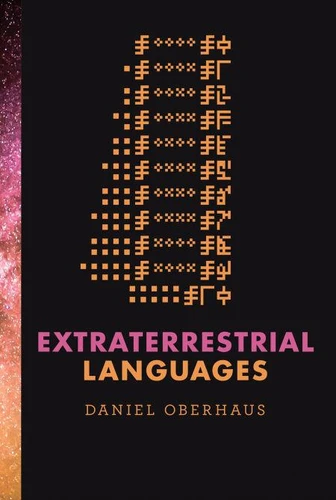
Extraterrestrial Languages
Par :Formats :
Disponible dans votre compte client Decitre ou Furet du Nord dès validation de votre commande. Le format ePub protégé est :
- Compatible avec une lecture sur My Vivlio (smartphone, tablette, ordinateur)
- Compatible avec une lecture sur liseuses Vivlio
- Pour les liseuses autres que Vivlio, vous devez utiliser le logiciel Adobe Digital Edition. Non compatible avec la lecture sur les liseuses Kindle, Remarkable et Sony
- Non compatible avec un achat hors France métropolitaine
 , qui est-ce ?
Notre partenaire de plateforme de lecture numérique où vous retrouverez l'ensemble de vos ebooks gratuitement
Pour en savoir plus sur nos ebooks, consultez notre aide en ligne ici
C'est si simple ! Lisez votre ebook avec l'app Vivlio sur votre tablette, mobile ou ordinateur :

- Nombre de pages264
- FormatePub
- ISBN978-0-262-35527-8
- EAN9780262355278
- Date de parution22/10/2019
- Protection num.Adobe DRM
- Taille657 Ko
- Infos supplémentairesepub
- ÉditeurThe MIT Press
Résumé
If we send a message into space, will extraterrestrial beings receive it? Will they understand?The endlessly fascinating question of whether we are alone in the universe has always been accompanied by another, more complicated one: if there is extraterrestrial life, how would we communicate with it? In this book, Daniel Oberhaus leads readers on a quest for extraterrestrial communication. Exploring Earthlings' various attempts to reach out to non-Earthlings over the centuries, he poses some not entirely answerable questions: If we send a message into space, will extraterrestrial beings receive it? Will they understand? What languages will they (and we) speak? Is there not only a universal grammar (as Noam Chomsky has posited), but also a grammar of the universe?Oberhaus describes, among other things, a late-nineteenth-century idea to communicate with Martians via Morse code and mirrors; the emergence in the twentieth century of SETI (the search for extraterrestrial intelligence), CETI (communication with extraterrestrial intelligence), and finally METI (messaging extraterrestrial intelligence); the one-way space voyage of Ella, an artificial intelligence agent that can play cards, tell fortunes, and recite poetry; and the launching of a theremin concert for aliens.
He considers media used in attempts at extraterrestrial communication, from microwave systems to plaques on spacecrafts to formal logic, and discusses attempts to formulate a language for our message, including the Astraglossa and two generations of Lincos (lingua cosmica). The chosen medium for interstellar communication reveals much about the technological sophistication of the civilization that sends it, Oberhaus observes, but even more interesting is the information embedded in the message itself.
In Extraterrestrial Languages, he considers how philosophy, linguistics, mathematics, science, and art have informed the design or limited the effectiveness of our interstellar messaging.
He considers media used in attempts at extraterrestrial communication, from microwave systems to plaques on spacecrafts to formal logic, and discusses attempts to formulate a language for our message, including the Astraglossa and two generations of Lincos (lingua cosmica). The chosen medium for interstellar communication reveals much about the technological sophistication of the civilization that sends it, Oberhaus observes, but even more interesting is the information embedded in the message itself.
In Extraterrestrial Languages, he considers how philosophy, linguistics, mathematics, science, and art have informed the design or limited the effectiveness of our interstellar messaging.