
Aurélie Manin est chercheuse CNRS au laboratoire Archéologie des Amériques à Paris. Camilla F. Speller est professeure associée au département d'anthropologie de l'Université de Colombie-Britannique à Vancouver, Canada. Eduardo Corona-M. est chercheur à l'Instituto Nacional de Antropología e Historia (INAH) à Morelos, Mexique, et membre du Système national des chercheurs du Conseil national de la science et de la technologie (CONAHCYT). Erin Kennedy Thornton est professeure associée au département d'anthropologie de l'université de l'État de Washington, à Pullman, États-Unis.
SOLDES
Jusqu'à -70% sur une sélection d'articles*
Nouveauté
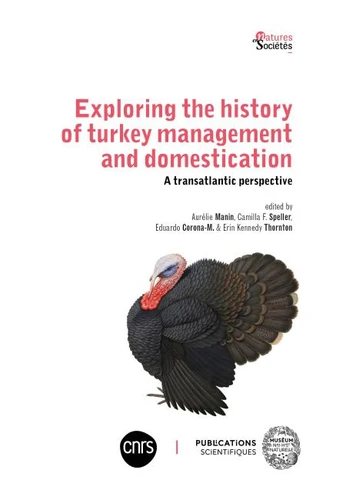
Exploring the history of turkey management and domestication. A transatlantic perspective 2025
Par : , , ,Formats :
Disponible dans votre compte client Decitre ou Furet du Nord dès validation de votre commande. Le format Multi-format est :
- Pour les liseuses autres que Vivlio, vous devez utiliser le logiciel Adobe Digital Edition. Non compatible avec la lecture sur les liseuses Kindle, Remarkable et Sony
 , qui est-ce ?
Notre partenaire de plateforme de lecture numérique où vous retrouverez l'ensemble de vos ebooks gratuitement
Pour en savoir plus sur nos ebooks, consultez notre aide en ligne ici
C'est si simple ! Lisez votre ebook avec l'app Vivlio sur votre tablette, mobile ou ordinateur :

- Nombre de pages406
- FormatMulti-format
- ISBN978-2-38327-027-0
- EAN9782383270270
- Date de parution11/06/2026
- Protection num.pas de protection
- Infos supplémentairesMulti-Format
- ÉditeurPublications scientifiques du Mu...
Résumé
This volume describes the origin of the turkey (Meleagris spp.), its domestication and management through time and across the world. After a first chapter dedicated to the evolutionary history, the biology and the distribution of the genus Meleagris, the volume is divided into two parts. The first part explores the early cultural history of the turkey in North and Central America across eight chapters dedicated to the Great American Southwest, Northern Mexico, Mesoamerica, Central America and Eastern North America.
It is caped by a last, trans-regional chapter, on the use of isotopes to understand turkey management and domestication in the Americas. The second part describes the global journey of the common turkey (Meleagris gallopavo), starting with its adoption in multiple European countries. Eight chapters explore the early depictions, testimonies and archaeozoological evidence in France, England, Italy, the Southern Lowcountries (modern Belgium and Netherlands), Austria, Czech Republic, Slovakia, Hungary, Lithuania, Poland and Estonia, with a chapter dedicated to the presence of the turkeys in cookbooks from France, Italy, England, Spain and Portugal.
The worldwide dispersal of domestic turkeys, their re-introduction to America through the colonial economy and further travel across the Pacific Ocean are addressed in two chapters to reach a better understanding of turkey husbandry and cultural symbol in the 21st century.
It is caped by a last, trans-regional chapter, on the use of isotopes to understand turkey management and domestication in the Americas. The second part describes the global journey of the common turkey (Meleagris gallopavo), starting with its adoption in multiple European countries. Eight chapters explore the early depictions, testimonies and archaeozoological evidence in France, England, Italy, the Southern Lowcountries (modern Belgium and Netherlands), Austria, Czech Republic, Slovakia, Hungary, Lithuania, Poland and Estonia, with a chapter dedicated to the presence of the turkeys in cookbooks from France, Italy, England, Spain and Portugal.
The worldwide dispersal of domestic turkeys, their re-introduction to America through the colonial economy and further travel across the Pacific Ocean are addressed in two chapters to reach a better understanding of turkey husbandry and cultural symbol in the 21st century.