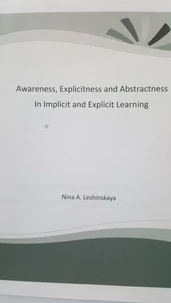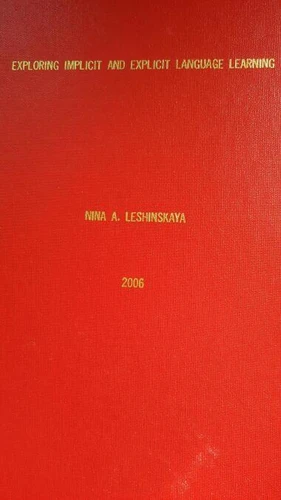
Exploring Implicit and Explicit Language Learning
Par :Formats :
Disponible dans votre compte client Decitre ou Furet du Nord dès validation de votre commande. Le format ePub est :
- Compatible avec une lecture sur My Vivlio (smartphone, tablette, ordinateur)
- Compatible avec une lecture sur liseuses Vivlio
- Pour les liseuses autres que Vivlio, vous devez utiliser le logiciel Adobe Digital Edition. Non compatible avec la lecture sur les liseuses Kindle, Remarkable et Sony
 , qui est-ce ?
Notre partenaire de plateforme de lecture numérique où vous retrouverez l'ensemble de vos ebooks gratuitement
Pour en savoir plus sur nos ebooks, consultez notre aide en ligne ici
C'est si simple ! Lisez votre ebook avec l'app Vivlio sur votre tablette, mobile ou ordinateur :

- FormatePub
- ISBN978-1-7382053-0-1
- EAN9781738205301
- Date de parution15/12/2023
- Protection num.pas de protection
- Infos supplémentairesepub
- ÉditeurNina Leshinskaya
Résumé
The question of implicit vs. explicit learning deals with the role of consciousness in human cognition. It has been claimed that implicit learning is an unconscious process that results in abstract, rule-governed knowledge. There have also been counterclaims that learning cannot be unconscious or that unconscious learning cannot lead to abstract knowledge. The debate is related to the role of explicit learning and teaching in second language acquisition.
If language acquisition is essentially implicit, the role of explicit learning/teaching is suspect. The essay explores the main conceptual issues in the area, drawing on research in cognitive psychology, second language acquisition, and views on the unconscious and consciousness in philosophy. Several kinds of implicit and explicit learning phenomena are idetified; however, the essay argues not for the dissociation but for the collaboration of implicit, explicit, and subconscious processes in Human Cognition in general and in language acquisition in particular.
If language acquisition is essentially implicit, the role of explicit learning/teaching is suspect. The essay explores the main conceptual issues in the area, drawing on research in cognitive psychology, second language acquisition, and views on the unconscious and consciousness in philosophy. Several kinds of implicit and explicit learning phenomena are idetified; however, the essay argues not for the dissociation but for the collaboration of implicit, explicit, and subconscious processes in Human Cognition in general and in language acquisition in particular.