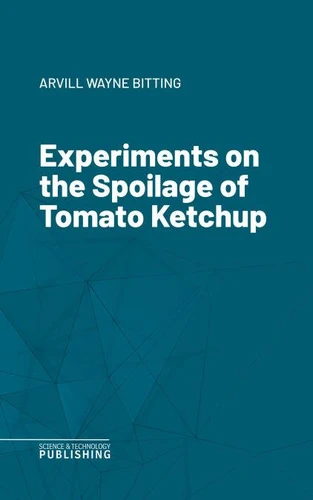
Experiments on the Spoilage of Tomato Ketchup
Par :Formats :
Disponible dans votre compte client Decitre ou Furet du Nord dès validation de votre commande. Le format ePub est :
- Compatible avec une lecture sur My Vivlio (smartphone, tablette, ordinateur)
- Compatible avec une lecture sur liseuses Vivlio
- Pour les liseuses autres que Vivlio, vous devez utiliser le logiciel Adobe Digital Edition. Non compatible avec la lecture sur les liseuses Kindle, Remarkable et Sony
 , qui est-ce ?
Notre partenaire de plateforme de lecture numérique où vous retrouverez l'ensemble de vos ebooks gratuitement
Pour en savoir plus sur nos ebooks, consultez notre aide en ligne ici
C'est si simple ! Lisez votre ebook avec l'app Vivlio sur votre tablette, mobile ou ordinateur :

- FormatePub
- ISBN978-2-5281-1327-1
- EAN9782528113271
- Date de parution01/09/2025
- Protection num.pas de protection
- Infos supplémentairesepub
- ÉditeurScience & Technology Publishing
Résumé
Experiments on the Spoilage of Tomato Ketchup is a comprehensive scientific treatise authored by Charles Thom and William T. Johnson, originally published as part of the U. S. Department of Agriculture's Bureau of Chemistry Bulletin in 1906. This detailed work investigates the causes, processes, and prevention of spoilage in tomato ketchup, a staple condiment in American households and food industries at the turn of the 20th century.
Drawing on meticulous laboratory experiments, the authors explore the microbiological and chemical factors that contribute to the deterioration of ketchup, including the roles of bacteria, yeasts, and molds. The book presents a thorough analysis of the conditions under which spoilage organisms thrive, the impact of various preservatives, and the effectiveness of different manufacturing and storage methods in prolonging the shelf life of ketchup.
Through a series of controlled experiments, Thom and Johnson document the effects of temperature, acidity, and sanitation on the quality and safety of tomato ketchup. They provide detailed descriptions of the experimental setups, the types of spoilage observed, and the identification of specific microorganisms responsible for fermentation, gas production, and off-flavors. The authors also discuss the implications of their findings for commercial ketchup producers, offering practical recommendations for improving product stability and consumer safety.
Rich with tables, charts, and scientific observations, Experiments on the Spoilage of Tomato Ketchup stands as a landmark study in early food science, reflecting the growing concern for food preservation and public health during the Progressive Era. This book remains a valuable historical resource for researchers, food technologists, and anyone interested in the evolution of food safety practices.
Drawing on meticulous laboratory experiments, the authors explore the microbiological and chemical factors that contribute to the deterioration of ketchup, including the roles of bacteria, yeasts, and molds. The book presents a thorough analysis of the conditions under which spoilage organisms thrive, the impact of various preservatives, and the effectiveness of different manufacturing and storage methods in prolonging the shelf life of ketchup.
Through a series of controlled experiments, Thom and Johnson document the effects of temperature, acidity, and sanitation on the quality and safety of tomato ketchup. They provide detailed descriptions of the experimental setups, the types of spoilage observed, and the identification of specific microorganisms responsible for fermentation, gas production, and off-flavors. The authors also discuss the implications of their findings for commercial ketchup producers, offering practical recommendations for improving product stability and consumer safety.
Rich with tables, charts, and scientific observations, Experiments on the Spoilage of Tomato Ketchup stands as a landmark study in early food science, reflecting the growing concern for food preservation and public health during the Progressive Era. This book remains a valuable historical resource for researchers, food technologists, and anyone interested in the evolution of food safety practices.