
Nouveauté
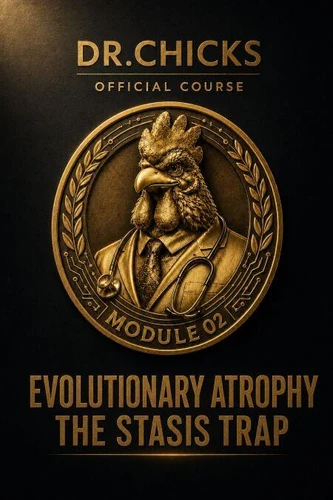
Evolutionary Atrophy & The Stasis Trap: Official Course Module (Week 2)
Par :Formats :
Disponible dans votre compte client Decitre ou Furet du Nord dès validation de votre commande. Le format ePub est :
- Compatible avec une lecture sur My Vivlio (smartphone, tablette, ordinateur)
- Compatible avec une lecture sur liseuses Vivlio
- Pour les liseuses autres que Vivlio, vous devez utiliser le logiciel Adobe Digital Edition. Non compatible avec la lecture sur les liseuses Kindle, Remarkable et Sony
 , qui est-ce ?
Notre partenaire de plateforme de lecture numérique où vous retrouverez l'ensemble de vos ebooks gratuitement
Pour en savoir plus sur nos ebooks, consultez notre aide en ligne ici
C'est si simple ! Lisez votre ebook avec l'app Vivlio sur votre tablette, mobile ou ordinateur :

- FormatePub
- ISBN8235970908
- EAN9798235970908
- Date de parution15/08/2026
- Protection num.pas de protection
- Infos supplémentairesepub
- ÉditeurIoakim Ioakim
Résumé
Renata built the product that made her division a category leader. Then she spent six years defending it instead of reinventing it - declining every proposal that might cannibalize her own numbers. Dr. Chicks calls this Evolutionary Atrophy, and it is not laziness. It is intelligence, correctly obeying a stale price signal. Evolutionary Atrophy: The Stasis Trap is Book Two in the Bio-Strategy series, and it admits a different patient than Book One: not the body that stopped moving, but the executive or organization that won, stabilized, and quietly stopped adapting.
The chapter opens the Clinic's case file on comfort itself - the most dangerous vital sign a leader can have. Three biological specimens anchor the diagnosis: the sea squirt that digests its own brain the moment it stops swimming and settles onto a rock. The cave fish that loses its eyes once light - and the metabolic cost of processing it - disappears from its environment. The dodo that traded flight for total safety on a predator-free island, until the predators arrived anyway.
Each is the same rule playing out at a different scale: natural selection does not preserve capability out of loyalty to the past. It preserves only what the current environment continues to price. Then the chapter goes fully quantitative. Arie de Geus's corporate-mortality research shows the average company lives 12.5 years against a biologically plausible lifespan of two to three centuries. The Gordon-Schaefer fishery model proves mathematically why an incumbent defending an undifferentiated position - without owning its niche - is structurally condemned to a zero-rent equilibrium.
Schumpeter's creative destruction and Arrow's Replacement Effect explain exactly why the monopolist who already collects the rents has less incentive to innovate than the entrant with nothing to lose. The chapter closes with two clinical prescriptions leaders can act on immediately: Cognitive Hybridization (AI as a synthetic cerebral ganglion, not a tool) and Ecosystem Orchestration (trading the brittle Monolith model for a resilient, sensing organization). Inside this case file: Two full case studies - one executive, one organizational - diagnosed with the identical atrophy The Nature gallery: sea squirt, cave fish, and dodo, each mapped to a business failure mode The hard science: the Gordon-Schaefer bioeconomic equilibrium, Schumpeter's creative destruction, and Arrow's Replacement Effect Arie de Geus's corporate-mortality data as the diagnostic baseline Two clinical prescriptions: Cognitive Hybridization and Ecosystem Orchestration The Business Translation - comfort converted into the P&L language leadership actually funds
The chapter opens the Clinic's case file on comfort itself - the most dangerous vital sign a leader can have. Three biological specimens anchor the diagnosis: the sea squirt that digests its own brain the moment it stops swimming and settles onto a rock. The cave fish that loses its eyes once light - and the metabolic cost of processing it - disappears from its environment. The dodo that traded flight for total safety on a predator-free island, until the predators arrived anyway.
Each is the same rule playing out at a different scale: natural selection does not preserve capability out of loyalty to the past. It preserves only what the current environment continues to price. Then the chapter goes fully quantitative. Arie de Geus's corporate-mortality research shows the average company lives 12.5 years against a biologically plausible lifespan of two to three centuries. The Gordon-Schaefer fishery model proves mathematically why an incumbent defending an undifferentiated position - without owning its niche - is structurally condemned to a zero-rent equilibrium.
Schumpeter's creative destruction and Arrow's Replacement Effect explain exactly why the monopolist who already collects the rents has less incentive to innovate than the entrant with nothing to lose. The chapter closes with two clinical prescriptions leaders can act on immediately: Cognitive Hybridization (AI as a synthetic cerebral ganglion, not a tool) and Ecosystem Orchestration (trading the brittle Monolith model for a resilient, sensing organization). Inside this case file: Two full case studies - one executive, one organizational - diagnosed with the identical atrophy The Nature gallery: sea squirt, cave fish, and dodo, each mapped to a business failure mode The hard science: the Gordon-Schaefer bioeconomic equilibrium, Schumpeter's creative destruction, and Arrow's Replacement Effect Arie de Geus's corporate-mortality data as the diagnostic baseline Two clinical prescriptions: Cognitive Hybridization and Ecosystem Orchestration The Business Translation - comfort converted into the P&L language leadership actually funds