Evidence as to Man's Place in Nature. A Victorian Perspective on Human Evolution and Zoological Studies
Par :Formats :
Disponible dans votre compte client Decitre ou Furet du Nord dès validation de votre commande. Le format ePub est :
- Compatible avec une lecture sur My Vivlio (smartphone, tablette, ordinateur)
- Compatible avec une lecture sur liseuses Vivlio
- Pour les liseuses autres que Vivlio, vous devez utiliser le logiciel Adobe Digital Edition. Non compatible avec la lecture sur les liseuses Kindle, Remarkable et Sony
 , qui est-ce ?
Notre partenaire de plateforme de lecture numérique où vous retrouverez l'ensemble de vos ebooks gratuitement
Pour en savoir plus sur nos ebooks, consultez notre aide en ligne ici
C'est si simple ! Lisez votre ebook avec l'app Vivlio sur votre tablette, mobile ou ordinateur :

- Nombre de pages644
- FormatePub
- ISBN4057664625441
- EAN4057664625441
- Date de parution26/11/2019
- Protection num.Digital Watermarking
- Taille1 Mo
- Infos supplémentairesepub
- ÉditeurGOOD PRESS
Résumé
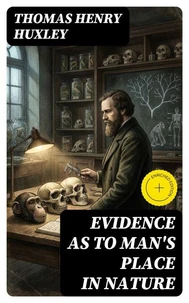
In "Evidence as to Man's Place in Nature, " Thomas Henry Huxley presents a meticulously crafted argument that places humans within the broader context of the natural world. Written during the late 19th century, a period marked by significant advancements in evolutionary theory, Huxley employs a scholarly yet accessible style to draw on anatomical, paleontological, and embryological evidence. With rigorous analysis, he examines the similarities between humans and other primates, ultimately arguing for humans'Äô evolutionary heritage in a way that engages with and challenges contemporary thought, particularly in the wake of Darwinian theories.
Huxley, often referred to as 'ÄúDarwin'Äôs Bulldog'Äù for his advocacy of evolution, was an influential biologist and philosopher whose background in comparative anatomy and zoology profoundly shaped his perspective. His commitment to empirical evidence and scientific inquiry set him against the prevailing creationist views of his time, leading him to explore the implications of evolution not only for science but also for society and philosophy.
His experiences and education culminated in this seminal work, positioning him as a pivotal figure in the acceptance of evolutionary theory. This book is essential for readers interested in the intersections of science, philosophy, and theology. Huxley'Äôs clear reasoning and passionate defense of evolution not only present a compelling case for human origins but also encourage reflection on humanity'Äôs place within the broader tapestry of life.
"Evidence as to Man's Place in Nature" is a vital reading for anyone eager to understand the scientific underpinnings of human identity and existence.
Huxley, often referred to as 'ÄúDarwin'Äôs Bulldog'Äù for his advocacy of evolution, was an influential biologist and philosopher whose background in comparative anatomy and zoology profoundly shaped his perspective. His commitment to empirical evidence and scientific inquiry set him against the prevailing creationist views of his time, leading him to explore the implications of evolution not only for science but also for society and philosophy.
His experiences and education culminated in this seminal work, positioning him as a pivotal figure in the acceptance of evolutionary theory. This book is essential for readers interested in the intersections of science, philosophy, and theology. Huxley'Äôs clear reasoning and passionate defense of evolution not only present a compelling case for human origins but also encourage reflection on humanity'Äôs place within the broader tapestry of life.
"Evidence as to Man's Place in Nature" is a vital reading for anyone eager to understand the scientific underpinnings of human identity and existence.
A propos de Thomas Henry Huxley


0,99 €
0,49 €
0,49 €