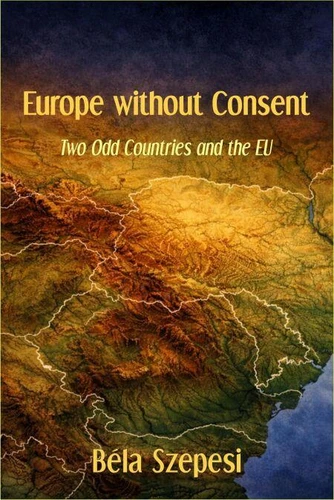
Europe Without Consent is a study of power, legitimacy, and the quiet transformation of the European project. Over the past decade, conflicts between Hungary and the institutions of the European Union have been framed as disputes over policy, values, or compliance. This book argues that they are something deeper. They are symptoms of a structural rupture between democratic self-rule and a system of governance that increasingly treats consent as optional.
Beginning with migration and demography, the book examines how certain questions have been removed from legitimate debate-not because they are settled, but because they are dangerous to ask. It traces how migration was elevated from a policy choice into a moral absolute, how demographic replacement was normalized, and how cultural continuity came to be treated as an embarrassment rather than an inheritance.
From there, the analysis moves to sovereignty. What does national self-government mean in a union where authority flows upward but accountability does not flow back down? When elected governments are praised only so long as they ratify prevailing orthodoxies, democracy becomes procedural rather than substantive. Elections occur, but outcomes are managed. The book then turns to the "rule of law, " revealing how a principle designed to restrain power has been repurposed as an enforcement mechanism.
Vague standards, permanent supervision, judicialized politics, and financial conditionality form an ecosystem that disciplines dissent without ever resolving it. Compliance is demanded, but never acknowledged. Alignment is expected, but never openly named. Hungary emerges not as an anomaly, but as a test case. Its significance lies not in size or power, but in persistence. By refusing to internalize a story it does not believe, Hungary exposes how consensus in Europe is often manufactured through pressure rather than persuasion-through reputational damage, elite signaling, and anticipatory obedience.
As ambiguity collapses, the book argues, Europe faces a choice it has long deferred. It can acknowledge sovereignty as real and pluralism as costly but necessary. Or it can continue down a path of centralization that requires intimidation to sustain itself. This is not a defense of isolation, nor a rejection of cooperation. It is an insistence that legitimacy cannot be automated, culture cannot be neutralized, and democracy cannot survive when disagreement is treated as delinquency.
Hungary's conflict with the European Union is not about Hungary alone. It is about what kind of Europe is being built, who authorized it, and whether a union that governs without consent can endure.
Europe Without Consent is a study of power, legitimacy, and the quiet transformation of the European project. Over the past decade, conflicts between Hungary and the institutions of the European Union have been framed as disputes over policy, values, or compliance. This book argues that they are something deeper. They are symptoms of a structural rupture between democratic self-rule and a system of governance that increasingly treats consent as optional.
Beginning with migration and demography, the book examines how certain questions have been removed from legitimate debate-not because they are settled, but because they are dangerous to ask. It traces how migration was elevated from a policy choice into a moral absolute, how demographic replacement was normalized, and how cultural continuity came to be treated as an embarrassment rather than an inheritance.
From there, the analysis moves to sovereignty. What does national self-government mean in a union where authority flows upward but accountability does not flow back down? When elected governments are praised only so long as they ratify prevailing orthodoxies, democracy becomes procedural rather than substantive. Elections occur, but outcomes are managed. The book then turns to the "rule of law, " revealing how a principle designed to restrain power has been repurposed as an enforcement mechanism.
Vague standards, permanent supervision, judicialized politics, and financial conditionality form an ecosystem that disciplines dissent without ever resolving it. Compliance is demanded, but never acknowledged. Alignment is expected, but never openly named. Hungary emerges not as an anomaly, but as a test case. Its significance lies not in size or power, but in persistence. By refusing to internalize a story it does not believe, Hungary exposes how consensus in Europe is often manufactured through pressure rather than persuasion-through reputational damage, elite signaling, and anticipatory obedience.
As ambiguity collapses, the book argues, Europe faces a choice it has long deferred. It can acknowledge sovereignty as real and pluralism as costly but necessary. Or it can continue down a path of centralization that requires intimidation to sustain itself. This is not a defense of isolation, nor a rejection of cooperation. It is an insistence that legitimacy cannot be automated, culture cannot be neutralized, and democracy cannot survive when disagreement is treated as delinquency.
Hungary's conflict with the European Union is not about Hungary alone. It is about what kind of Europe is being built, who authorized it, and whether a union that governs without consent can endure.


 , qui est-ce ?