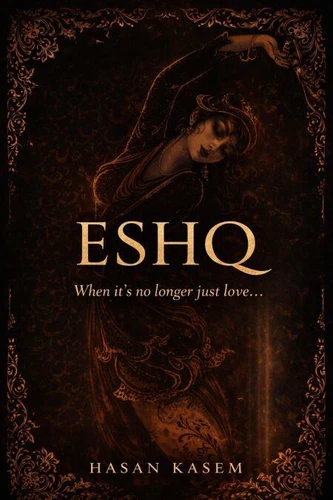
This is not a book about love. It is a book about what love does to you. In ESHQ, Hasan Kasem enters the territory beyond romance: the place where desire becomes fire, fire becomes exile, and loss becomes a doorway."Eshq is the distancethe moth refuses. It is the name of the fireafter fire has ceasedto be an enemy."What begins with a glance becomes an unraveling. A man is undone by longing, intimacy, absence, grief, and finally by his own reflection.
Moving through eight stations - Thirst, Fire, Exile, The Dark Night, First Light, Reckoning, The Tavern, and The Beloved - ESHQ traces the transformation of human love into something stranger and larger. Here, heartbreak is not merely an ending. It is revelation. Drawing from Persian lyric imagery, Sufi mysticism, and lived experience, Kasem explores the dangerous boundary between the human beloved and the Divine: the place where the lover discovers that the face he worshipped was never the destination, but perhaps a window.
This is love without sentimentality. Love as hunger. Love as wound. Love as annihilation. Love as awakening. For those who have loved and lost. For those who are still burning. For those who discovered that what broke them was also changing them. This is not healing. This is awakening.
This is not a book about love. It is a book about what love does to you. In ESHQ, Hasan Kasem enters the territory beyond romance: the place where desire becomes fire, fire becomes exile, and loss becomes a doorway."Eshq is the distancethe moth refuses. It is the name of the fireafter fire has ceasedto be an enemy."What begins with a glance becomes an unraveling. A man is undone by longing, intimacy, absence, grief, and finally by his own reflection.
Moving through eight stations - Thirst, Fire, Exile, The Dark Night, First Light, Reckoning, The Tavern, and The Beloved - ESHQ traces the transformation of human love into something stranger and larger. Here, heartbreak is not merely an ending. It is revelation. Drawing from Persian lyric imagery, Sufi mysticism, and lived experience, Kasem explores the dangerous boundary between the human beloved and the Divine: the place where the lover discovers that the face he worshipped was never the destination, but perhaps a window.
This is love without sentimentality. Love as hunger. Love as wound. Love as annihilation. Love as awakening. For those who have loved and lost. For those who are still burning. For those who discovered that what broke them was also changing them. This is not healing. This is awakening.

 , qui est-ce ?